Author: Justin Rivelli

  • This Way of Thinking Changed My Life (Part One)

    This Way of Thinking Changed My Life (Part One)

    “When things go wrong, don’t go with them.”- Elvis Presley

    Michael Jordan, Babe Ruth, Emily Dickenson, Abraham Lincoln, Jerry Seinfeld and almost every other person you know has failed before they got to where they are today. Every person I have ever met, worked with, or talked to has failed in one way (or 100, or more) before they reached their goals. I don’t like the word failure. I think it is one of the most misunderstood and improperly used words to exist. It’s right up there with the word “hard” which I think should be changed to “doable”. But getting back to the word failure, I’ll let Thomas Edison explain one reason why we interpret and utilize this term so poorly before we move on.

    •  “I have not failed. I’ve just found 10,000 ways that won’t work.”- Thomas A. Edison
    • “Many of life’s failures are people who did not realize how close they were to success when they gave up.”-Thomas A. Edison

    Let’s Relate This to Fitness

    For example, what if you go on a fat loss plan for a couple months and you don’t lose any weight or lower your body fat percentage at all. Let’s say you try ten different programs and still nothing. You’re left feeling upset, disappointed, and as if there is no hope. Have you failed or can you learn from this particular “fault”? If you keep “failing” at anything, ask yourself these three questions very carefully.

    1. When, where, and why did I fail?
    2. At what point in my life did I fail?
    3. How will I prevent this “failure” from happening again?

    But please don’t kid yourself.

    If you are serious about getting results, then answer the questions above in the way you deserve too. Truthfully. Why? Because they will not work if you are lying to yourself. If you are not seeing results because you are not complying or putting in full effort to a program just say so. At least you know the real reason why you failed and you can still learn from that.

    It is impossible to live without failing at something, unless you live so cautiously that you might has well not have lived at all, in which case you have failed by default. – JK Rowling

    I absolutely love that quote. If you thin failures are bad, it’s going to make believing in yourself near impossible when you get knocked down. Mistakes happen, and as you already know they will keep happening for the rest of your life. Fail the right way,  which is by going after what you want.

    I believe you should indeed let failures affect you, but not destroy you. Embrace them, love them, and be grateful for their limitations. Failures are temporary and can only go so far and last so long. They can’t resist success. Think about it…

    Imagine what would happen if health care providers quit when a treatment wasn’t working. The possibility of finding a solution is impossible. In the same sense, if you quit when going after a goal, the possibility of “winning” is non existent. Do you agree that then you will never know what you could have achieved if you don’t at least try? This is what sets the average and the successful apart.

    Failures and how you deal with them are the foundation to the person that you become.

    You see, if you don’t give what you want to a shot, you never know if you could have stricken gold. Would you rather win, lose, or say you didn’t try weeks, months, years, or decades from now? I don’t now about you but I don’t want to have any regrets at all in the one life I am given. We usually hear that we don’t try things because we are afraid of failing.

    I also think you should ask yourself if you are afraid of the APPEARANCE of failing. If you were in your room alone and nobody could see you fail at the task you set out for, would you still be scared to go after your dreams and goals?

    Don’t think like the people that believe you can’t start a business during the recession. The people that think motivated people can’t turn phenomenal. The people that say things are impossible because they aren’t you. They aren’t capable of what you are. Remember, being born means that you were made to grow and to live life to the fullest. Don’t let failures kill you. Don’t let failures destroy your dreams. When something bad happens look at the good first, then look at the bad and decide how you’re going to fix it. Deep down you know there is always more out there. Do me a favor and remind yourself of this everyday.

    P.S. If you were to die tomorrow, would you have achieved everything you wanted?

    Don’t be a pessimist. We all recognize the same situation, bad or good, effects different people different ways. Our lives are most effected by the way we think things are, not the way they are. As you think, so you become. From now on what I want you to take away from this post is that you didn’t “fail”.

    Stop living cautiously and safely and instead live wisely and venturesome. Only you can control your own thoughts, and if you decide not too someone else will. We don’t want to live a scared, protective, boring life, we want to live an exciting intrepid one.

  • You Probably Don’t Use This Style of Training But You Should

    You Probably Don’t Use This Style of Training But You Should

    In this article you will learn…

    1. What tempo training is.
    2. How and why to utilize it.
    3. Mistakes and corrections in the application of it.

    Tempo Training: “The Break Down”

    In simple terms, coming from a musician, tempo is defined as the speed or pace of a given “piece”. In a fitness sense, it’s the speed or pace of a given “exercise”.  Although every movement we perform has a specific tempo naturally and without thinking, manipulating and/or paying attention to it is something you may benefit from.

    What do the numbers mean?

    This is how the parameters of an exercise are usually set up. Today we’re looking at the italicized tempo portion.

    Exercise: Back squats
    Sets: 5
    Reps: 3
    Rest time: 120-180 seconds
    Tempo: 6-3-2-2

    The first number (6) is the eccentric or lowering portion of the exercise: Here the muscle is lengthening while its getting worked. For example, this would be the lowering of a bar during a bench press, or the straightening of your arm while performing a biceps curl.

    The second number (2) represents the pause in between the lowering and lifting portion of the exercise. This pause usually happens between the eccentric (lowering) phase and the concentric (lifting) phase of a repetition. An example would be when the bar is nearest your chest in the bench press, or when the arm is fully extended during a bicep curl.

    The third number (3) is the concentric, or lifting portion of the exercise: The concentric contraction occurs when the muscle is shortening. Examples of this would be the pushing movement of the bar during a bench press, or the flexing (bending) of your elbow during a biceps curl.

    The fourth number (2) explains the pause at the top, if you choose to include that: The contraction happens at the end of your concentric (lifting) portion. Examples would be at the top or lockout position with the arms straight at the top of the bench press, or when your elbow is fully bent at the top of a biceps curl.

    Note:

    • If you want to use, or see someone uses an (X) it means to perform that phase of the movement as fast as possible.
    • If you want to use, or see someone uses a (0) it means you spend no time pausing at either the top or bottom of the exercise.

    Tempo training can be implemented to achieve all types of goals. You can use it too…

    Increase your strength and power

    https://www.instagram.com/p/61AbrsxMVZ/?taken-by=justinrivelli

    Increase muscle hypertrophy (muscle growth)

    You can manipulate tempo to increase things like metabolic stress (the burning feeling when you train), mechanical tension (in simple terms using the heaviest loads you can handle) and or to increase muscle damage (by using a long eccentric contraction or unfamiliar movements).

    Identify weaknesses, correct poor technique, or help with problem areas throughout an exercise. 

    By using different tempo’s (whether they are fast, paused, or slow) it enables you to see and feel certain positions and problem areas throughout the four phases of an exercise. This way you can gain better awareness of your body in space.

    Improve body control, technique, and quality of movement.

    For example if you struggle keeping a neutral spine near the bottom of a stiff legged deadlift, I could change the tempo so that you spend more time there to either create more confidence, strength, or familiarity in that position. I can even do it to give you a greater return of proper technique for the future.

    Be aware of counting too fast.

    Being a drummer my whole life I like to think I have a great sense of time and tempo. What I often notice is that because using slower tempos is challenging, people count inconsistently, and quicker than they think they are.

    So how do you fix this?

    1. You can look at or listen to a stopwatch or metronome, which sometimes can get annoying.
    2. Have someone count for you, which will require a partner.
    3. Count slower with one-one thousand, two-one thousand, three-one thousand.

    Or what I have also seen work great is…

    1. Check and re-check an actual stopwatch from time to time, to make certain you are accurately counting the number of seconds properly.
    2. Double the amount of time you want to perform, to ensure you’re counting slow enough.

    The ways you can use tempo training are endless.

    Here are a couple videos of me applying some different tempos.

    Tempo training will give you a greater appreciation of an exercise, especially if you are getting bored and need to step out of some old habits. Pick a primary goal and execute numbers appropriately. If you need help with something specific, feel free to comment or message me.

  • “The Friendly Five” I Dare You to Try This Complete Core Challenge

    “The Friendly Five” I Dare You to Try This Complete Core Challenge

    In this article I’m going to teach you…

    • How to hit your entire “core” in one swipe either at home or in any training facility.
    • Some sample exercises, modifications and progressions so you can make this routine easier, more challenging, and so you are able to switch things up after a while.
    • How to perform the exercises properly, common mistakes, and how to fix them with video and picture demonstrations.

    Let’s hop right into this.

    Category One:  Core training using anti-extension exercises

    This is where you will be training your “six pack” by preventing your lower back from arching. Using proper terminology you will be preventing lumbar extension and using your rectus abdominus.

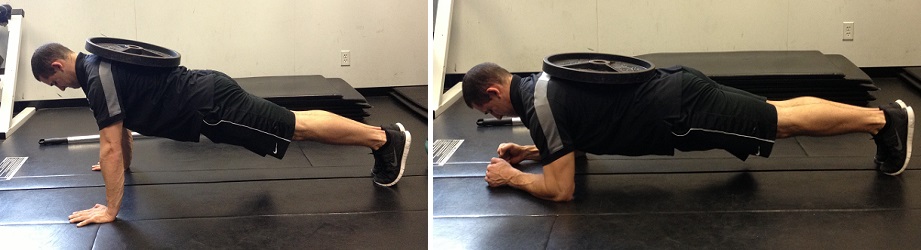
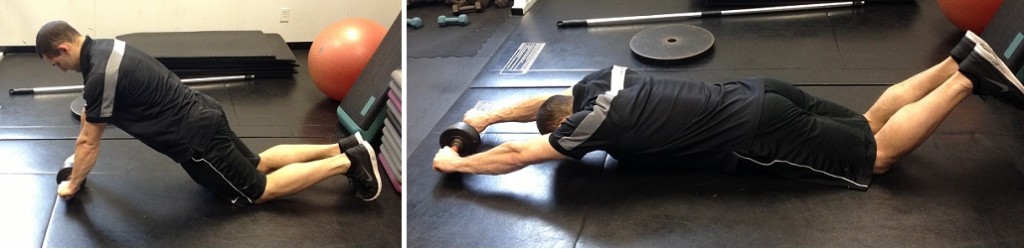
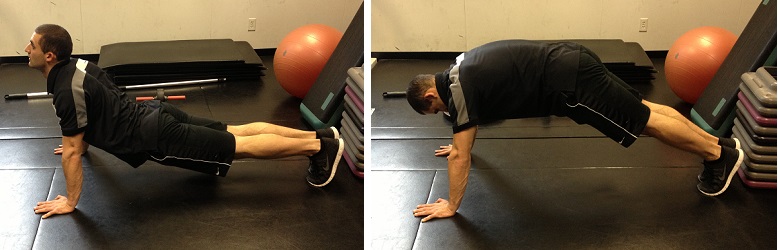
    Exercises like planks, push ups, ab dolly, stability ball, or barbell rollouts, suspension fallouts etc. belong in this category. The pictures below represent a logical sequence of planks with the difficulty ranging from less challenging (hands elevated on the bench) to more challenging (elbows on the floor). There are many more variations but this is a very simple progression to follow.

    plank progression

    They are even more challenging if you add weight on your back, or movement of the limbs with maintaining the proper core and spinal positon.

    plank progression 2

    ab dolly rollout

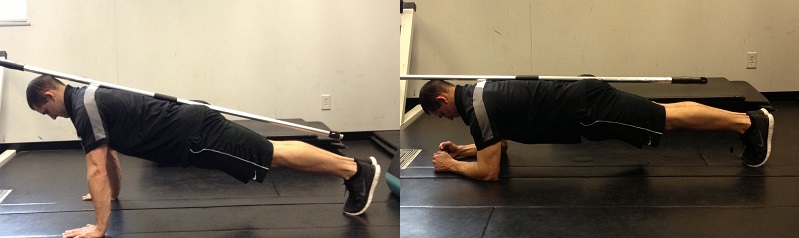
    For these exercises it would be beneficial of you follow the technique dowel rod rules I presented in this popular article “You Must Learn This Before You Start Training” here.  This is one of the quickest ways to make sure you have good body alignment. I’ll show you again below anyways.

    During ANY anti-extension exercise you can double check your technique by making sure a dowel rod maintains contact with the back of your head (occipital region), in between your shoulder blades (scapula), and on your tailbone (sacrum).

    If you lose contact in one of those spots during a movement or exercise, something is out of alignment. Both these examples show poor positioning.

    bad planks1bad planks2


    To correct it, just reassure the dowel rod is in contact with the back of your head, in between your shoulder blades, and your tailbone like mentioned above.

    plan 2


    Some other important cues are to make sure you are getting the most out of these ant-extension exercises:

    1. Squeeze the glutes and quadriceps.
    2. Keep the ribs down and the stomach tight.
    3. Don’t let the shoulder blade protrude away from your back. This is where the vertebral border of the scapula lifting away from the thorax.
    Category Two:  Core training using anti-rotation exercises

    In Laymon’s terms this is where you are not letting your body twist through your stomach and lower back. You will be hitting your “love handles”. Using proper terminology you are resisting rotation through the core and lumbar spine.

    Exercises like palloff press variations (kneeling, 1/2 kneeling, standing etc.), landmine rotations, tornado ball exercises, and rotational cable push pull exercises without letting your spine rotate will do. Look below to see some examples. We all now by now the key is to not let the core or lumbar (stomach or low back) move.

    Anit-rotation: Half kneeling and standing palloff presses in the pictures below.

    Half kneeling Palloff progression


    Standing Palloff Press progression

    Category Three: Core training using anti-flexion exercises

    Using proper terminology you are resisting flexion through your lumbar spine. In simple terms you are not allowing your lower back to round while an external load is trying to make you do so.

    Exercises in this category include squat and deadlift variations, all types of carrying exercises (goblet, front loaded, and zercher carries), reverse hypers, and back extensions. The key again is keeping your core and lumbar (stomach and lower back) in neutral alignment.

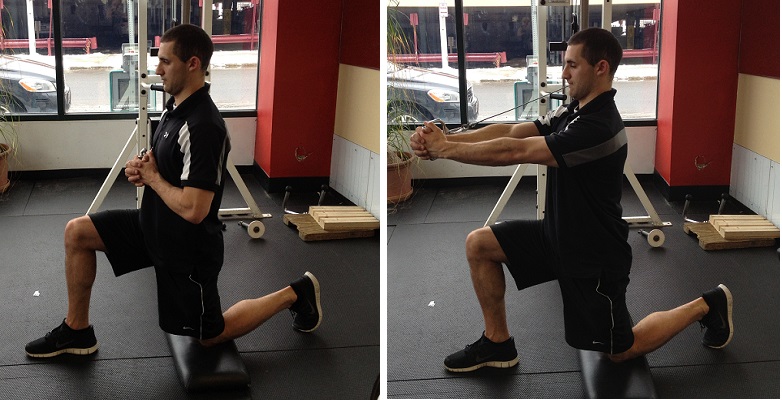
    You can even hold an object in front of you with bent or extended arms while keeping your core and lumbar in neutral alignment.

    Here are some anti-flexion example exercises…

    Category Four: Core training using anti-lateral flexion exercises

    This is where you are preventing your body from bending to the side through your lower back. You will be using your “love handles” yet again. Using proper terminology this where you are resisting lateral flexion through the lumbar spine.

    Exercises in this category include side plank and offset carrying variations.

    Side Plank


    Category Five: Core training using hip flexion with a neutral spine

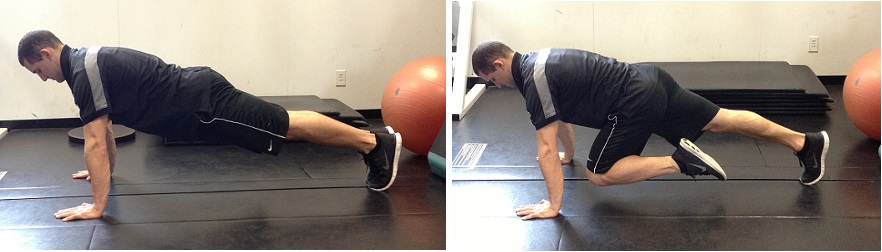
    To break this down in simple terms, your keeping your stomach and low back straight, while simultaneously pulling your knee (s) upward. Using proper terminology you will be keeping your core and lumbar spine in a neutral position, while flexing either one or both hips.

    Exercises in this category include hanging leg raises, leg lowering variations, mountain climber or knee drive variations, stability ball jackknifes etc.

    Below I give you some examples.

    Stability Ball Knee tuck progression

    extended no dowel and knee


     “The Friendly Five” Challenge

    Now that you have just learned some sample exercises, technique, and regressions and progressions let’s move onto how this challenge is going to be performed. It’s a pretty simple five steps.

    1. Five exercises: Pick one from each category mentioned above.
    2. Five minutes: Each exercise will be performed for one minute.
    3. Five “breaks”: You can take up to five “breaks” whenever you want throughout the five minutes.
    4. Five seconds rest: You can only take five seconds rest at each break. That’s twenty five seconds rest total within the five minutes.
    5. Five high.  I mean, a high five. Yes, you get one personally from me. But that’s only for those who complete the challenge. Show me a video of yourself performing this and I’ll give you some daps.
    “The Friendly Five” Example (Worksheet)
    1. Anti-Extension: Front Plank (1 minute)
    2. Anti-Rotation: Landmine rotations (1 minute)
    3. Ant-Flexion: Stiff Legged Deadlift (1 minute)
    4. Anti-Lateral Flexion: Side plank 30 seconds/side (1 minute total)
    5. Hip Flexion w/Neutral Spine: Stability ball knee tucks (1 minute)
    “The Friendly Five” Home  Edition Example (Worksheet)
    1. Anti-Extension: Extended front plank with shoulder taps (1 minute)
    2. Anti-Rotation: One arm wall alternating squeezes (came up with this exercise and couldn’t think of a clever name) (1 minute)
    3. Ant-Flexion: Extended object press outs  (1 minute)
    4. Anti-Lateral Flexion: Side plank 30 seconds/side (1 minute)
    5. Hip Flexion w/ Neutral Spine: Mountain climber slider (1 minute)

    If this is too challenging for you, feel free to make the exercises you chose easier until you can progress. If it’s still too difficult break “The Friendly Five” down into something like this. 

    Ground Rules:

    1. Pick one exercise from each section above.
    2. Perform each exercise for 45 seconds.
    3. Rest 15-30 seconds in between each exercise.
    4. Rest 60 seconds after all the exercises are completed.
    5. Repeat for three rounds.

    If you did this easily you can…

    • Increase the difficulty of the exercise
    • Decrease the amount of rest in between exercises
    • Decrease the amount of rest in between rounds
    • Incorporate all three

    How do you program this into your current routine?

    • Perform this before you train.
    • Add it to the end of a training session.
    • Perform this at home or on “off/conditioning/GPP” days.
    • It really can be done whenever you wish.

    If you want to hit your entire core in five minutes, then give this a shot. Just make sure your technique is up to par and you’re picking exercises that actual challenge you specifically. With the modifications, progressions, and variety of exercises given their anyone can perform this. So grab a partner go after it, and show me a video of you doing it if you wish.

    P.S. If you have picked the right exercises for yourself you will soon find out “The Friendly Five” isn’t so friendly after all. It may take some experimenting with, but try it out, and let me know how it goes. 

  • You Must Learn This Before You Start Training (For Ladies and Gentlemen)

    You Must Learn This Before You Start Training (For Ladies and Gentlemen)

    In this article I’m going to teach you three things…

    1.  Why you need to learn the hip hinge before you begin any type of training program..
    2.  The mistakes I come across in just about every client when coaching it.
    3.  How to correct these exact errors.

    WHY LEARN THE HIP HINGE?

    If you cannot perform a proper hip hinge, you should not be attempting some of the most important and popular exercises being taught or performed today. These include the deadlift, kettlebell swings, and rowing variations etc.

    In person, I rarely work with someone that can initially perform a good hip hinge.  Without question it usually takes in depth proper teaching, practice, grooving and loading to understand. In simple terms it takes repetition. Actually, proper repetition with the objective to get better is more like it.

    The hip hinge is often overlooked in training facilities, rehab centers, and in everyday life. I cannot believe more personal trainers, athletic trainers, physical therapists, chiropractors, and orthopedics, etc. do not make sure they themselves and their clients or patients know how to perform it.

    Since no amount of treatment or therapeutic modality is going to cure this movement, I believe it is my job to teach every single one of you how to do it. It’s not only appropriate but necessary you can feel the difference between loading a movement through your spine (and other unwanted areas), and loading a movement through more appropriate places like your hips and hamstrings.

    Whether you are picking up something up and putting it down, shoveling, tying your shoes, or getting up from a toilet seat, a proper hip hinge will spare you the repetitive unwanted trauma that will lead to inefficiency and injury.

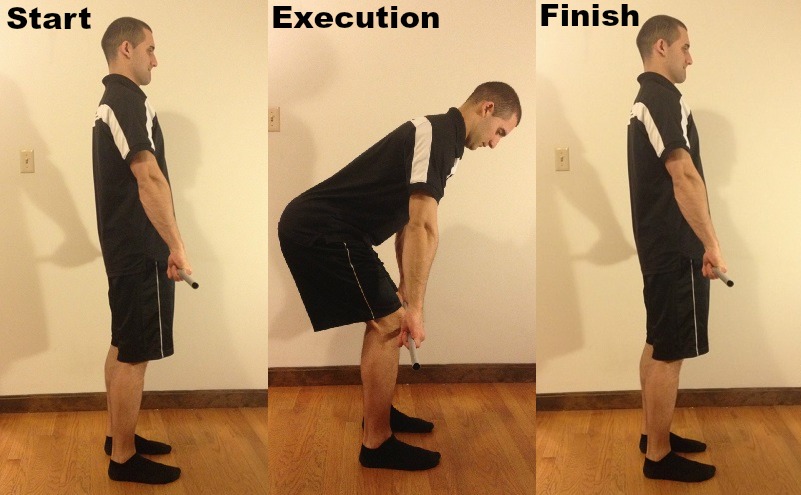
    Here is what a good hip hinge looks like before I present, assess, and correct common mistakes of it.

    pic monk hing

    HERE ARE FOUR COMMON MISTAKES OF THE HIP HINGE ND HOW TO CORRECT THEM:

    Problem One: The hinge isn’t a squat. 

    Hip Hinging involves reaching the hips back, not dropping the butt down. Dropping the butt down, causes your weight to translate forward, not back.

    Hip Hinge Mistake One


    If you stood with your knees against an object, they would hit it, or you would push it forward. This is incorrect. See what I am talking about in the video below.

    SOLUTION!

        1. Imagine taking a bow, not a curtsey.
        2. Picture someone is standing behind you, wrapped a rope around your waist, and is pulling you backwards
        3. Have a partner stand in front of you, put their hands on the front of your hips (ASIS), and push you backwards as you perform the hinge. If you don’t have a partner, karate chop your own hips while doing this.
        4. Place an object in front of you and don’t let your knees come forward
        5. You should feel your glutes and hamstrings (back of your thighs) loaded and stretched.

    If you were standing in front of an object and performing it correctly, your knees wouldn’t touch it at all. Look below to see a hip hinge where the hips are reaching back, but not dropping down:

    Or you could even do this next to a wall to help fix your butt dropping problem.

    Problem Two (s): Legs remain straight throughout the entire movement, excessive rounding or arching occurs, butt doesn’t go back.

    In layman’s terms, excessively rounding or arching the back is not favorable for long term bone, or joint health. This is usually accompanied with straight knees, and the butt not going back as well.

    Hyperextended Knees and Lmbar Flexion


    SOLUTION!

        1. Stand close to a wall and put a dowel rod in between your elbow pits (cubital fossa) behind your back.
        2. Reach your butt back to the wall.
        3. Move further away from the wall as you progress.

    dowelrod behind back use


    Problem Three: Using your lower back, not your hips to finish the lift.

    The first mistake I see in this category is “leaning back”. This is where people use lumbar (lower back) extension, instead of hip extenison. The second mistake I see is where people do not use hip extension or their glutes at all. They are both shown in the pictures below.


    Solution:

        • Stand up tall
        • Squeze your glutes/pinch a penny between your butt cheeks
        • Push your hips through.
        • Hump the air.
        • Lock out your knees and hips
        • Keep the ribs down/abdominals tight
        • Get tight like your about to get hit by a bus

    Proper Hip Extension


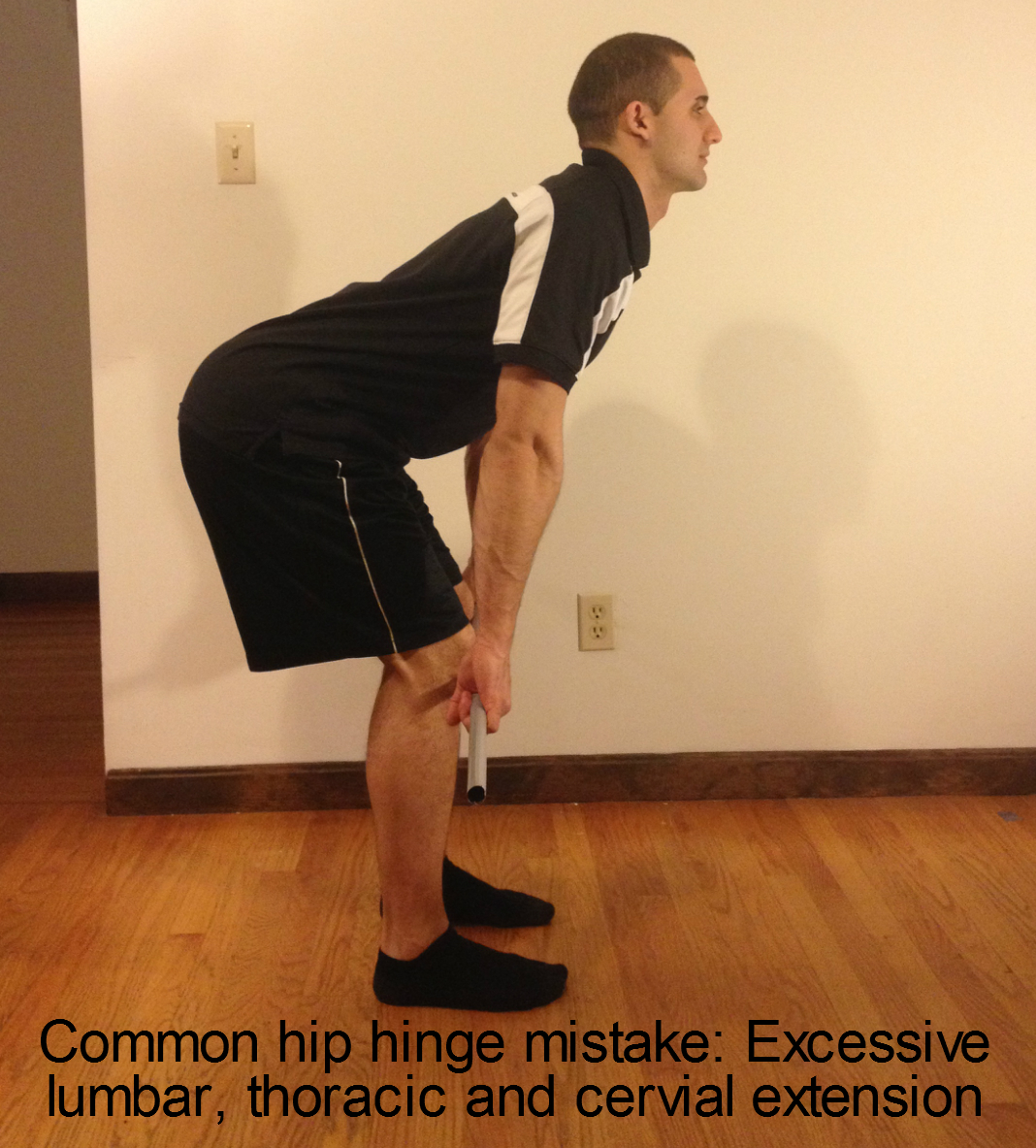
    Problem Four: Hyperextending the low back, upper back, and or neck.

    This might be less serious than the other problems for the majority of the population, especially seeing some coaches teach this position on purpose. But for the most part learning neutral alignment instead of hyperextending everything is a smarter safer choice. It’ll not only help with performance of other lifts, but create awareness of positioning as well.

    Lumbar, thoracic and cervial


    Solution: 

    1. Place a dowel rod, tick, broom, or whatever you have onto your back.
    2. Perform the hip hinge.
    3. During the movement make sure it maintains contact with the following three places. The back of your head (occipital region), in between your shoulder blades (scapula), and your tailbone (sacrum).
    4. If you lose contact, something is out of alignment. To correct it, just reassure the dowel rod is in contact with the three areas mentioned above.


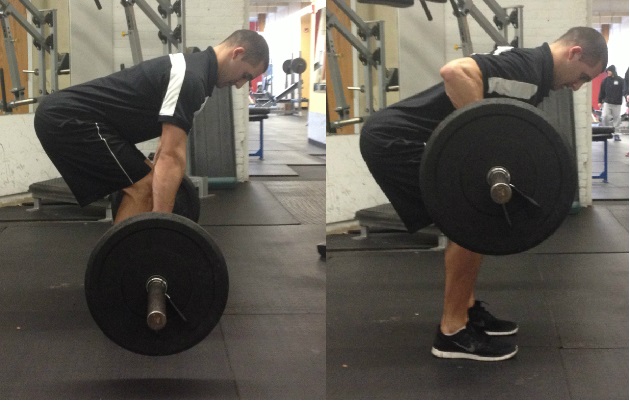
    If you stuck with me this long so far, thats great! Now let’s take a quick look at some exercises that involve the hip hinge I taught you above. I left out pictures of kettlebell swings,  good mornings and certain Olympic lifts etc. Just note exercises other than the ones presented below will require you know the hip hinge in order to be performed.

    Bent over barbell rowing:


    Bent Over Rear Deltoid Raises:

    Rear Delt Raises Bottom

    Stiff Legged Deadlifts:


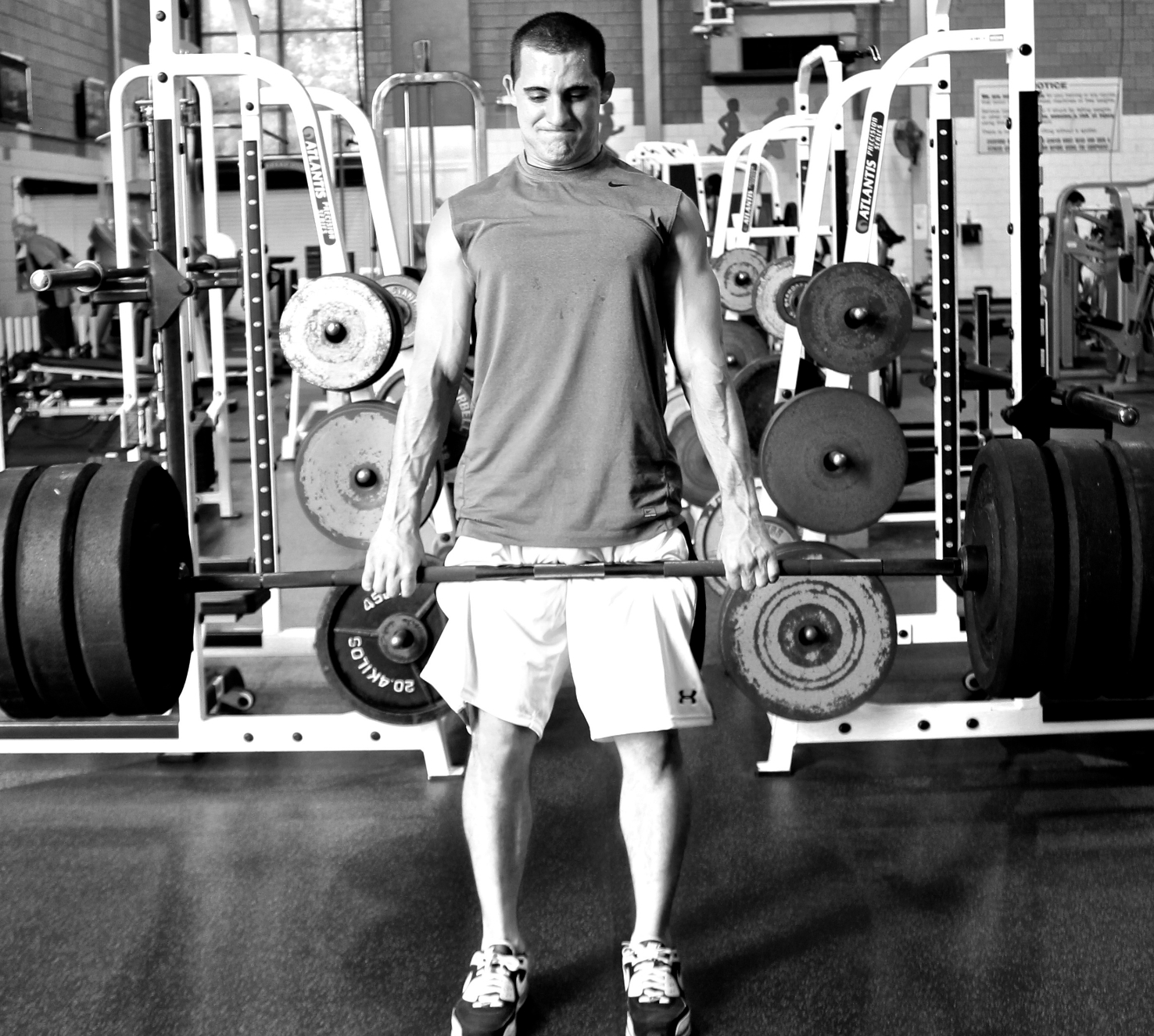
    And finally, a short clip of the conventional deadlift using the hip hinge correctly.

    By learning the hip hinge you will not only enhance your physique and performance, but prevent injury and increase your training years more than you can imagine. It will also help you look like you’re an advanced trainee, lifter, gym rat or whatever you want to call it. Whether you’re at a gym, moving a sofa, picking up grocery bags, or playing with your child at a bouncy house, you will be a master of this movement anywhere you go if you implement what I just showed you.

    P.S. If and only if this post helps you please feel free to share it with anyone you believe could benefit from it.

  • Protected: Fat Loss Disaster’s Part Two: Compliance

    This content is password-protected. To view it, please enter the password below.

  • Fat Loss Disaster’s Part one: Kitchen Mistake & “Shake Trick”

    We all know the kitchen plays a tremendous role in where your physique, performance and health is made. A lot of stuff could go extremely wrong or strikingly awesome. In other words, it’s where the majority of the magic happens, especially when you’re dealing with fat loss. I not only wanted to share with you some very common problems I see at JRPT, but also how I have found to solve them.

    Problem #1: You’re preparing meals and or cooking while your hungry.

    Now, that may not seem like such a heroic statement alone especially if you don’t cook for yourself (or at all). But when do most people get hungry and eat “crap”? The majority of people tell me when they get home from work or in between meals times while COOKING, they are “starving”. I mean food is literally at the tip of your fingers. This is a very common time people dive into whatever they can which leads to less than optimal fat loss results.

    Solution: I call this “The Shake Trick”.

    To perform this trick you must have a protein shake, or a high protein meal in the fridge at all times. I wish I had more to tell you but as Porky Pig would say, that’s all folks. Saying that, here are some guidelines.

    1. All magic tricks require preparation, so when you make this shake triple the serving size you would normally eat. Yes triple it.
    2. While you are cooking, take out 1/3 of the shake and drink it at a slow to moderate pace while cooking.
    3. Leave the rest in the refrigerator for next time.

    Some other cool things about this are…

    • You can adjust the shake to fit your macronutrient (carbohydrate, protein, fat) needs.
    • They take a long time to drink, especially if you add a lot of ice.
    • They are ridiculously satisfying, quick, delicious and easy to consume.
    • Unless it’s called for to eat a lot at one meal later in the day, the shake trick prevents you from overeating or housing food at dinner or junk while waiting to eat.

    An example shake (shown in pic above): Gather up a fruit of your choice (optional), 1 scoop of a protein powder, some healthy fats (natural nut butter, extra virgin coconut oil etc.), add some water and ice to the mixture, then blend. If you want to consume some extra carbohydrates, feel free to add something like quick oats right into the blender as they mix incredibly well. You can also add something like unsweetened cocoa powder, ground cinnamon, or any other natural seasonings according to your taste preference. Just get creative. This takes about 2-3 minutes.

    Problem #2: When food is available to you, someone (probably you) will eventually eat it.

    I agree with this by Dr. John Berardi over at Percision Nutrition because I have noticed the same patterns with just about every single person I have coached, minus a few exceptions. I also may be wrong here but I personally believe it still counts even if nobody see’s you eat that ice cream. “I ate it, but didn’t want to. I had no intention of eating this but I did.” So let me get this straight, you ate it but you didn’t plan to, nor did you even want it in the first place. It all makes perfect sense…

    The Solution: Remove, Replace, Re-evaluate and Re-adjust

    Again, I also agree with some of Dr. John Berardi’s solutions here as they work fantastic. I have just added a little twist with adding the re-evaluate and re-adjust pieces to the situation, even though I am sure he does this as well.


                                    (Before)                                                                (After)

    (Here’s and example of being halfway through a client re-vamp. You tell me when a person will be more successful. Note there are actually many more “non cabinet” foods in the house now, and it took a little while to get to this point.)

    Remove the garbage: Fat loss is a lot easier when you create and environment that’s easier to achieve it in. Get all the stuff you shouldn’t be eating out of your house and it’s impossible to eat it. I know it’s easier said than done but it’s possible. Try to get extra support from the people who live with or are around you, and explain to them why your doing this. More on this in a moment. 

    Replace it with better options: Give your kitchen a new “feel” and look, and you will in turn feel, look, perform, be a lot healthier as well. By simply replacing things like fruit juice with real fruits, hydrogenated peanut butter with natural nut butters, and white bread with sprouted grain breads etc. it makes a huge difference. While doing this try to find things the people you live with and that surround you will eat as well. Work with each other and this will be a more enjoyable situation.

    Re-evaluate the situation and re-adjust if needed: This is self explanatory but re-evaluating is just as important in nutrition as it is in fitness, rehabilitation and in life. Without going into too much detail, if you don’t have a coach, it’s your job to figure out if the overhaul is working. Test and re-test on a continuous basis.
    *Bonus boo boo’s for parents and guardians: Don’t buy food and say you did so because your kid “needs” it.

    You bring your kids to the doctor, dentist, and even make sure they wear there helmets and seat belts, but the safety portion missing is often nutrition. This subject is one huge part that could limit doctor’s visits in the first place. Fix the cause of problem’s not the result of them.

    If you want the best for your child, the truth is they should be eating healthy too. If you cook and eat healthy meals your children will eat them with you. If you don’t feed your children junk then they won’t eat it. (At least while they are around you). I am not saying deprive them, I am just saying that the majority of the time people don’t realize kids like healthy foods. When I hear things like, my kids LOVES that natural peanut butter on celery now, or mommy can I have a piece of fruit, what is that telling you? Get and give the kid more healthy foods and let them eat a good amount of them.

    If it’s not their fault and they really don’t like the new food choices you have provided, all you must do is find another healthy food substitution or recipe they do like. I  recognize it’s easier said than done and it could take some work and time, but is your child’s health worth it? Then put your thing down flip it an reverse it! (OH NO, DID I REALLY JUST SAY THAT?!) There is a fine ground between making everyone satisfied. Understand that I don’t have children, but also notice that I witness patterns where it’s a lot less difficult for families to eat better when children are INCLUDED in the nutritional/life change. Just remember, small adjustments at a time.

    (Don’t be demanding like Harry Wormwood from Matilda, instead form a cooperative style relationship around edible materials.)

    If I did my job today, I have just made you aware of three very common problems while on a healthy fat loss journey and how to solve them. I understand “magic” is supposed to be kept secret, but use the shake trick I showed you and make more people aware of this easy solution if it works for you. More importantly, go after the kitchen overhaul and start replacing anything you can. Don’t let your children “get in the way” but rather INCLUDE them and find things they like as well. While doing these things monitor yourself and others, and see if they better your progress. The next Uh-Oh installment will be in your vision soon:)

  • Get Awesome Results (Part 3): How “Winner’s” Think

    Before we start, let’s clarify what a winner is. For the purpose of this post a winner is anyone who survived the Zombie invasion and the end of the world on December 21, 2012. Congratulations! On a more serious note, a winner can be defined as anyone who enjoys what they do while accomplishing a goal they aim too. Below I listed how “winner’s” think and how to fix some “losing” qualities you may have. Do you generally have a “winning” or a “losing” mindset? Let’s find out.

    “Winner’s” STRIVE for success, they don’t try to AVOID failure.

    Are you motivated to get better or are you motivated to avoid failure? Which way do you think and what’s the difference?

    • With the “winning” mindset you strive for awesomeness.
    • You blame your lack of success on your own EFFORT not your ABILITY. Saying this, to get more awesome, all you have to do is try harder. This way FAILURE will INCREASE your motivation not decrease it.
    • You will take responsibility for your failures and credit for your successes. This will also give you confidence to succeed repeatedly.

    Opposing the way “winners” think, “losers” focus on avoiding failure.

    • They are filled with self doubt.
    • They believe their failures occur because of a lack of ability and or infrequent successes.
    • They blame themselves for failure and take minimal to no credit when they achieve success.

    Coaching note:

    You also see these “losers” stop putting forth effort to protect their self worth. If people knew they tried hard and still failed, others would “know” they didn’t have the ability to succeed. To help solve this problem you would have to do things like build on success, set personal goals etc. like I mentioned in the past two articles “Coaching the M word” and “How to Progress”.

    They don’t think they know everything.

    (of course this is bad)

    Nobody knows everything. If someone did or at least thought they did, they would never learn anything new. The quote that’s been floating around the strength and conditioning world for quite some time now is “the more you learn the more you find out you don’t know”. It’s one of the truest statements I have ever heard.

    “Winner’s” arms are open, even they do belong to a “tribe”.

    I’ll explain this in the fitness realm since that is the purpose of this blog. I am defining a “tribe” as a group which possesses certain qualities and characteristics that make it a unique. Before I get more in depth, let’s think about this in the simpler mindset.

    In general, a lot of people do Yoga because they are naturally able to get into crazy positions, just like a lot of people do bodybuilding because they are naturally muscular. We all know that bodybuilders could become more mobile and flexible if they did Yoga, which would in turn could decrease chance of injury and give them the ability to get into better positions so they can perform better. Where on the opposite hand people who practice Yoga could get stronger, become more aware of how to fire muscles, and decrease some excessive laxity in their joints if they did some other types of training.

    Taking it a step further and for example #1, let’s take a look at…Yogies:

    Since most people are not even near as mobile or as flexible as they should be Yoga is fantastic. It’s even good for people who can’t relax, or for anyone who just plain likes it and it gets them moving. But saying this there are a lot of yoga fanatics, teachers and people out there who promote it for different types of dysfunction or pain either because it has “worked for them” or for whatever else it may be. The reality is, certain dysfunctions along with things like back, neck, hip and shoulder pain etc. are very complex problems. Not all problems have the same exact underlying cause and Yoga could (and sometimes does) make a particular problem worse. When it comes to being put into hypermobile positions, not everyone deserves to, nor should they be trying to get there. Of course with a good Yoga mentor, they do understand things like this and that other methods and modalities are better options to treat injury or dysfunction.

    For example #2 let’s look at CrossFit:

    I am not going to ramble on about how CrossFit seems to cause a lot of SLAP tears, UCL, or lumbar injuries like a lot of other people seem to be doing, but instead I will explain what is beneficial about it, so you understand my point of how you should not get “set in your ways”.

    Besides, what about all the other “general fitness certified trainer’s” that cue bad technique causing injuries (acute or chronic) or that neglect soft tissue work or proper warm ups to prevent injury? I am around your average “trainers” almost all day and see very few doing any prophylactic work or that pay attention to detail (technique, nutrition, sleep, stress etc.). Instead everyone seems to be bashing CrossFit coaches and tearing them down. Instead let’s try to make ALL PEOPLE who coach aware of the most effective and safest training methods out their according to their client’s goals.

    Now that I am off that tangent…

    I like CrossFit for the idea that it gets women to lift weights, the average crowd moving, and it gives people a sense of meaning and feeling of comradery. It also gets some people eating better with the Paleo diet they support. CrossFit brings about and forms some of the most dedicated fitness individuals I have seen in a long time. But saying this, some die hards take it way too far as I have heard the following things said recently…

    “You are starting football soon? You should do CrossFit. CrossFit makes you good at Olympic lifting. I want to get big, I’m going to start CrossFit” Doesn’t that just sound a little off to most of you?

    Even though I think CrossFit would contribute to achieving the above goals, I also believe it is a jack of all trades master of none type of fitness. It makes you good at many things, but great at none. Think about it, if you want to be good at Powerlifting, Olympic weightlifting, a particular sport or bodybuilding etc. you have to specialize. Again, the intelligent and knowledgeable people who practice CrossFit do understand this. They understand the reality of what it is, does, and can do. These people are a rare person to find from my current personal experience.

    To sum this up, you can see how I am far from being a CrossFitter, nor do I practice full on Yoga, but I am open to what they preach, can learn things from them, and do recognize these forms of practice benefit people in certain ways. In the fitness world, don’t just eliminate all other forms of exercise once you find your niche or because you hear something bad about it. Research it, ask questions, try it for yourself, seek out people who are good at it, etc. Then form your own opinion. Even still, in my eyes there is no need to shoot anything down as you can always learn keeping an open mind.

    Successful people challenge beliefs. Even the most popular information that’s supposed to be right.

    Successful people aren’t afraid to do anything or bring up controversial ideas. I love the quote from a TED talks video I saw a couple years ago that I’ll never forget by sir Ken Robinson. He said “If you’re not prepared to be wrong, you’ll never come up with anything original.” I believe successful people are not afraid of what other people think even though they do value others opinions. If you always go with the crowd and worry about how someone might criticize you, you will never have room to grow and be creative on your own.

    A lot of stuff we are taught is wrong anyways. Question everything, and believe in the information you find measurable and that actually works. I will post real life examples of this in the future to prevent to article from getting longer than it already is!

    Winner’s surround themselves with other extremely successful people.

    Successful people usually find people that are the best at what they want to do and learn from them.  If you want to be good at what you do learn from willing reliable sources and trust them. They know what works and will leave out a lot of the “dirty work” or “headaches” you don’t have to deal with.

    In the past two articles I wrote about how you can’t motivate people but you can create and environment to get people to motivate themselves. By surrounding yourself with winner’s you are one step closer to an ideal environment. Don’t miss out on opportunities of learning from the best people you can find. It may change your outlook on things forever. Usually talking to these people is like striking gold.

    Note: There will be certainly be other ways of achieving your goals and I 100% encourage experimentation and originality like I mentioned above, but saying this let’s read the next statement…

    Successful people run away from analysis paralysis.

    This refers to or over-thinking a situation so that a decision or action is never taken. For the purpose of fitness,  this problem causes people over analyze “what to do next” because of the limitless possibilities. In other words, they overwhelmed by and don’t act. That is obviously not good.

    Their movement is not limited by their mind.

    Winner’s are confident and know they can achieve anything.

    By this I simply mean you can do anything even if your mind tells you not too. We have standards of everything. Whether its a world record time, a level of leanness you want to achieve, or even a GPA you want to achieve.

    You think your muscles are tired on a high rep set? I guarantee most of you could do an extra 5-10 reps (YES 5-10 REPS) even while keeping form if you really pushed yourself. I’m not saying do it all the time, I am just saying more is possible than you think. My point again is most people limit themselves way too much because of what they see, here, or believe. They do what their mind or body tells them which is sometimes not so fantastic.

    Look at the 4 minute mile. Now I am not a runner but I understand it was first achieved in 1954 by Roger Bannister in 3:59.4. Now his record is broken, and the “four minute barrier” as they call it is the STANDARD of all male professional middle distance runners. Even though we do have advanced training techniques etc. I believe just seeing it was possible was the biggest breakthrough for many.

    One of the biggest reasons I love my job is that the things I have seen clients accomplish blow not only their own minds, but friends, family members and everyone around them who ever has doubts. Proving them wrong is great and all, but just that feeling of success is unexplainable.

    Before I conclude, here are 18 more really important bullets about “winner’s” I want to throw at you without explaining too much.

    1. Nobody has time. Successful people make time.
    2. They know there is no shortcut to success. Hard work is the habit of 99% of successful people.
    3. Winner’s inspire each other, challenge one another, uplift and encourage everyone. They make other peoples lives better.
    4. The best of the best are constantly growing and learning. They are constantly working at mastering there craft.
    5. Winner’s follow through. They do what they set out too.
    6. They constantly visualize the future, can see the end result, and know what they have to do to get do to get there.
    7. They know “why” they are doing not just what.
    8. Once they become locked in, THAT’S IT. Any threats or negative remarks DO NOT effect them.
    9. The best learn from experience, successes and failures.
    10. They set realistic personal goals, monitor and evaluate progress, then adjust accordingly.
    11. The more they learn the more they realize they don’t know.
    12. There is no room for a bunch of negative self talk in a winners mind. Positive words like I am doing this, rather than I might be able to do this are the norm.
    13. They believe in, love and are passionate about what they do, ensuring forever progress and learning.
    14. They find things that work best for them.
    15. They study both sides. For example do want to be healthy? Then study health, but also study the unhealthy.
    16. They know what’s going on around them, not just in front of them.
    17. They focus on what matters, not the miniscule b.s. everyone else worries about.
    18. They appreciate other people more.

    By having these winning qualities you can become unstoppable. You can accomplish what you aim to, and even what you never thought was in your reach. By changing your expectations and implementing most of the above steps, I believe you will become the best of the beasts. Good luck on your journey and get to becoming much more awesome.

    References:

    Successful Coaching. Fourth ed. Champaign: Human Kinetics, 2012. Print.

  • Get Awesome Results (Part 2): Coaching the “M” Word

    (Even watching Rocky won’t keep you motivated for long)

    The phony idea of pumping people up, intense yelling, or even a “motivational movie” will most likely NOT cure unmotivated people to create lasting change. This is an inadequate way of thinking about this misunderstood and poorly implemented word. My goal for this post it to teach you more about the “m” word, how to maximize it’s potency and duration, and solutions to make motivation “work”. With that said, let’s get right to it.

    Motivation is literally the desire to do things. I believe every coach who understands the “m word” does not try to motivate others per say. People who want to accomplish something and have lasting must find a way to motivate themselves. Now saying this, (if you’re a coach) it’s your job to help guide them to do so. Below I list some pointers on how to go about doing this. Here we go…

    1. First, you must have control and be able to motivate yourself before trying to help someone else do so.

    Practice what you preach. Seriously. If you hate what you do and you’re trying to help someone at it, they will hate it too. If you’re bad at what you do or do, or you do not like what you’re doing, people can see right through you and they will in turn be bad at it too. Don’t you love the people who are awesome at what they do and or are excited for life? Aren’t you inspired by them? Passion is contagious.

    If you are one of those people who already have a passion and are good at what you do, learn what is that’s motivating you so you can inspire and help others. Just remember, when it comes to dealing with people everyone is different. You will read about this more specifically below.

    2. Have other “testimonials” or highly successful people being coached by you lead by example and inspire others.

    I think every coach needs individuals that lead by example and show others what is actually possible. Whenever you can show others demonstrating awesome levels of success it is fantastic, a reflection of what you do. Know who these “gems” of clients are, tell them, and keep developing and helping these people. They will become your “secret powers” that will lead and help others achieve ridiculous results and better progress. Inspiration and it’s power is a topic that will be brought up in part three of this series “How Successful People Think”.

    3. To help a person to motivate themselves, you must appeal to THEIR values.

    One of the major things you must figure out when trying to motivate another person is to recognize their values and what’s important to each and every one of them. Ask questions like…

    1. What matters most to you today?
    2. For what reasons do you want to achieve whatever it may be?
    3. What value do you place on a achieving these goals?

    Whether the goal is the same as yours or the opposite it does not matter. For example in the training sense, some people value hard work, where others are just happy to participate. Some value being with their family, others don’t. A simple often overlooked way to do this is to actually ask and LOOK AT and evaluate people’s lifestyles, starting points, goals etc. so you can help them determine what they can realistically achieve and how long it will take. It goes a long way.

    4. We do things because we want to fulfill our needs, we enjoy them, and because they matter.

    When you or others are not enjoying the process, feeling worthy or successful, I can almost guarantee you have lost motivation. Gain a clear understanding of what your client wants to get out of fitness and life. Understanding people as individuals will help you understand how reaching their goals will CAUSE them to reach their fitness and life goals. Find out why others are unmotivated. Do they even want to achieve something. Have they become bored? What can you do to bring them back to life and help them set an awesome goal they want to achieve. Some questions to ask could be…

    • Do you feel a sense of meaning?
    • Did you get caught up in the sense that you’re doing this because you think you have to?
    • Why are your clients signing up?
    • What do they want to achieve?
    • Who is important in their life?
    • Who do they want to please or make proud if anyone?
    • What are their hobbies?
    • What is their lifestyle like inside and outside of work?
    • How many food pushers, anti-fitness people or “threats” do they receive each day?

    Continuing on this idea, if you are looking to be successful at what you do, for the most part intrinsic drive (doing things because they matter, you want to, you enjoy them) will out-weight extrinsic drive (rewards, money etc.) any day of the week. This is the secret to high performance. According to Dan Pink, the science confirms this and proves it over and over again. If you want to know more about this guy look him up. His new ideas on business and how management is not needed are pretty incredible as well.

    5. Catch people when they do something good.  But before you do so, there’s another “catch” you must know as well.

    Complimenting people all the time on things they always do good get’s old. Instead, notice and praise people for great performance and on things they don’t normally seem to “get”.  Then they will see you really understand and care about them.

    For example, if your training a group and Sally always has great deadlift technique or always seems to eat a good breakfast, don’t repeat back, “terrific form!” or “nice discipline with breakfast this morning” every time. She will know in her head,” I always do this, whats the big deal?”

    On the other hand if John has terrible deadlift form, and you see him make an improvement, this is the time to give him a pat on the back, show some praise and shout out “excellent lift!” or something along those lines according to your personality. Acknowledge what he achieved and he will know you are not missing anything. Or in other words you pay attention to him ALL the time and notice what hes doing. Show the people you genuinely care.

    6. Have a  proven system in place, and set realistic goals WITH your clients not FOR them. Along with this, teach others to gain control of their individual success.

    Anyone can set a goal for someone but if they don’t want it in the first place you might as well flush it down the toilet. To create a successful environment where people can motivate themselves, help others develop goals that will lead to results they want. I believe successful people and coaches know what triggers each person to get strive for and reach success.

    Obviously setting SMARTER (Specific, Measurable, Attainable, Realistic, Timely, Evaluate, Re-evaluate, Satisfactory) guidelines/goals are great. By doing this “the right way” at the least you will…

    • Be honest with yourself and lay out a good starting point. You must have total honesty about where you are at.
    • Have better time management
    • Have more self confidence now that you believe goals are possible
    • Know what expect from yourself
    • Understand what value you place on achieving a goal.

    I believe that when people achieve success, it keeps them “going”. It also boosts self confidence, and gives them hope there is light at the end of the tunnel. Having a coach that can see the future is a plus, but if you don’t have one that can or even one at all, just understand that if you’re not making progress something has to either be changed, modified, or progressed.

    7. MEASURE, show and explain to people what is possible once you have the above figured out. Set people up for success!

    I understand everyone is very different but if you explain  “on average” what happens, at least you have a starting point and something to work with. For example, with my systems if I have someone going for fat loss this is what I show them. Feel free to make something like this on your own but do not show anything if you cannot 100% guarantee it!

    Average weight loss in the first week (primarily water and glycogen) Average weight loss each week after
    More than 200 lbs 2 to 7 pounds 1 to 3 pounds
    Less than 200 lbs 2 to 5 pounds 1 to 2 pounds

    With measuring let’s stick with this idea of fat loss. If you never follow through and measure your progress, you will never know if you’re getting better or worse. Not dragging on just measure more often. No not everyday but more often. Measure at the same time and day every week. On the other hand, if you’re going for strength log your numbers. Etc. etc. etc.

    What not to do when setting goals…

    Have you ever had a coach or someone that compared you to the someone else with different genetics, tendon insertions, genders, ability levels? If they are comparing you to the best player you don’t have a shot of being like for a while or at all how do you think that will make you feel? If so, when you fail you and your coach will both be disappointed and in shock even though you did your best with the tools you had. Sometimes its impossible to reach certain desired outcomes and this failure crushes people, especially children.

    That said I believe 99% of people limit themselves way too much, and that everyone can reach goals much higher than they ever thought possible. For example if you have always carried a bit to much body fat and or think, “I’ll never look like I used too”, you are already limiting yourself and it’s not true. I guarantee you can get A LOT leaner than you think with the proper effort, consistency and intensity.

    8. Like I said in part one of this series, when setting goals find the optimal activation point.

    • For some people, if you set a goal is too hard: They will get anxiety, feel pressured, and get overwhelmed when trying to accomplish it.
    • Whereas for others if the goal is too hard: They will feed off of the challenge and get 10000 times better.

    It’s your job to understand yourself and or your clients. Don’t let people fail all the time who get worse by doing so. Don’t let people always achieve success easily when failing will make them bust there tail even more. Set goals near the upper limits of your own or other people’s individual abilities but not too hard to achieve. If the goal is too hard, you/they will fail, if it’s too easy you/they will become bored. It’s a very simple process often overlooked.

    9. Stop dabbling, stop “shoulding” and stop trying.  Passion, inspiration, commitment and consistency are what matters.

    (Counting how long you last here will definitely help you fail)

    For example, if you’re counting the days you have stuck to a new nutrition or training system that’s not going to stick forever. It’s really not that cool how long you lasted if it doesn’t make you better or help you grow to produce the results you are really after. You’re just seeing how many days you can last. Patience has a lot to do with this. We all expect things to fast. When what we want doesn’t happen “right now” we jump to the next thing.

    Everyone screws up, gets stressed, depressed, or in general just has mess ups. The real thing to think about is how did you get past this crisis? Consistency. passion and setting yourself up to win is the key. If you’re not inspired, what do you have? With passion and inspiration you feel alive, excited and in control of your life. A ridiculous combination for consistency, progress, happiness and success.

    Touching on the trying debate: “I am trying to do this because”…”I should do this because”…PLEASE STOP RIGHT THERE! Do not pass go, and do not collect $200.00. Trying or shoulding doesn’t work. Why MUST you have this? In short list and lay out strong reasons for achieving your goals instead.

    Now to conclude this abruptly and out of nowhere…Hopefully after reading this post you will now go watch 3 motivational movies, and have someone yell in your face to do something. Kidding! But on a serious note if you read over an implement the ideas above on how to create a successful environment to motivate yourself and or others, you will find a better road map to achieve some awesomeness!

    References:

    Successful Coaching. Fourth ed. Champaign: Human Kinetics, 2012. Print.

  • Protected: Get Awesome Results (Part 1): How to Progress

    This content is password-protected. To view it, please enter the password below.

  • Protected: 111 Lessons For Better Fitness Results and a Healhier Life

    This content is password-protected. To view it, please enter the password below.