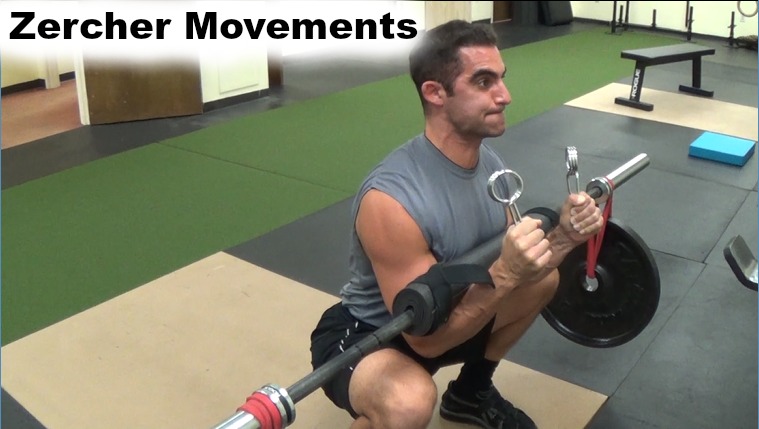
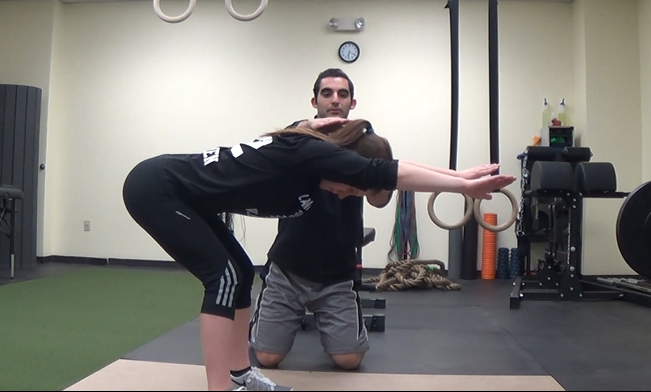
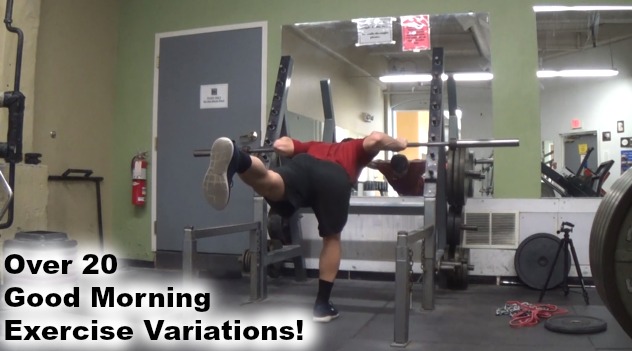
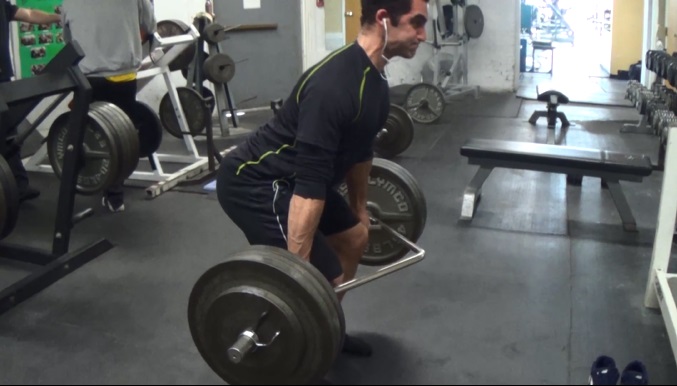
Here are some Zercher movements that can bring your physique and performance to the next level. I also added in a bunch of variations I’ve been experimenting with I’ve never seen performed before. If you want your quads, glutes, core, biceps, and upper back to scream, try these.
Any questions or coaching inquiries can be sent to rivelli.justin@gmail.com, or to my Facebook page here. Thanks for watching!
I’ve had the pleasure and opportunity of coaching people from all walks of life, through training and nutrition programs both in person and online for over a decade. With that said, I’ve noticed a great deal of them are often misguided, disinformed, or uneducated when it comes to getting the body fat reduction results they desire.
Especially where I’m currently located in Pittsfield, the largest city and the county seat of Berkshire County, Massachusetts.
In this post I’m going to supply those of you who want to get leaner, with four common training and nutrition mistakes, as well as solutions to these issues, to help you reduce body fat.
Mistake Number One: Not Prioritizing Energy Balance
A negative energy balance alone, where you take in less calories than you expend, will be responsible for bodyweight reduction, independent of the method used (Strasser et al. 2007) (Hall et al. 2015).
For example, whether you choose to eat a high or low carbohydrate diet (Golay et al. 1996) high or low fat diet (Noakes et al. 2005), consume more or less meals (Bellisle et al. 1997) etc. (Leibel et al. 1992) a net negative energy balance will be required for weight loss.
However, most people desire to lose body fat, not lean muscle mass, when weight loss is their goal.
This is why I explain more reliable ways to track and measure progress, different reasons bodyweight fluctuations occur, and clarify resistance training misconceptions and more in the paragraphs below.
Note: I don’t want to move on without saying the energy balance system is interactive and complex: a change in one component can affect one or more other components (Hall et al. 2012). For example, look at my Facebook post below where I explain how nonexercise activity thermogenisis (NEAT) varies between two people of similar size by up to 2000 kcal per day (Levine 2007).
Nonetheless, the overall message here is that energy balance (the relationship between energy in (calories consumed) and energy out (amount of energy expended or used by the body) matters when it comes to body fat reduction. The strategies you use to manipulate this (training and diet wise), will vary from person to person, and will depend on things like your primary goals, behaviors, and lifestyle.
Mistake Number Two: Making Decisions Without Context
Before you give, receive, or use advice, what are the circumstances of which you’re basing your judgement off of?
For example, if someone asks you, “What foods should I avoid when trying to lose weight?” “How many days of cardio should I perform if I want to get leaner?” or, “Will eating before bed make me gain weight?”, you cannot give them a valid and reliable answer without knowing the rest of their circumstances.
Case in point, you can refrain from eating any foods you desire, perform cardio seven days a week, or use any supplement or fat loss trend you come across, but if you do not create an energy deficit or consume less calories than you expend, you’re not going to lose weight (Buchholz, Schoeller 2002).
If you’re making decisions, asking questions, or giving advice about body fat reduction without context, your action, inquiry, or input probably isn’t going to matter.
Mistake Number Three: Not Properly Resistance Training | Misinterpreting “Cardio”
Weight loss is different than fat loss. Many people who want to loseweight, often care more about body fat reduction than an arbitrary number the scale spits out.
The scale measures your weight, not your fat free mass. This is exactly why I talk about body weight fluctuations and what factors can cause it to rise and fall, that have nothing to do with actual fat loss or fat gain in the next section.
However, this doesn’t go without saying that both weight loss and fat loss are generally required for folks to reach their body composition goals.
More lean muscle mass at the same body weight = more “muscle tone”. Less lean muscle mass at the same body weight = less “muscle tone”.
In other words, when you have more lean muscle mass at the same body weight, you will have less body fat. This also means that if you have less lean muscle mass at the same body weight, you have more body fat.
With that said, what is the quickest way to “tone” your physique when it comes to physical activity? Resistance training focusing on progressive overload (Russell et al. 2000)
If you’re wondering what progressive overload is, in simple terms it means doing more over time. Whether that is by using more weight for the same number of reps, performing more reps with the same weight, or using more range of motion with all other parameters constant, etc., an increase of stress placed upon the body over time will assure the principle is being applied.
Many people who desire body fat reduction are quick to do extra cardio, take more classes, use less rest time, perform higher reps with lighter weight, and/or abandon weight training all together.
This is fine if you’re interested in body weight loss and nothing else. However, if you’re interested in “toning” your physique in the fastest way possible, by gaining or preserving strength or muscle mass, resistance training wins (Bayner et al. 1999)
When you gain strength over time by using heavier loads, you force the muscles to adapt by growing. If you take away those heavier loads when dieting down, you lose the adaptation. Therefore you end up losing more muscle mass than you would have if you stayed lifting heavier weights, in the long run. This is the reason gaining or trying to maintain strength (the primary contributor to muscle growth Shoenfeld 2010) should be executed when on a fat loss diet.
Important notes:
When you’re on a fat loss diet, progressive overload is more difficult to implement as you don’t have the extra calories to support things like your training and recovery time. Therefore you can’t train as hard as you normally would with more food.
Generally speaking, unless you’re a beginner or untrained lifter (where you will receive the best of both worlds by gaining muscle and strength and losing fat at the same time) the hypocaloric diets required for fat loss may cause you to lose some muscle strength and muscle mass.
Intensity has been shown to have a significant impact on muscle hypertrophy and is arguably the most important exercise variable for stimulating muscle growth. Shoenfeld (2010). Shoenfeld (2010), also reports use of high repetitions has generally proven to be inferior to moderate and lower repetition ranges in eliciting increases in muscle growth. Although such high rep training can bring about significant metabolic stress, the load is inadequate to recruit and fatigue the highest threshold motor units.
Oh and a couple more things…
https://www.instagram.com/p/_AxzyhRMSj/
Strength training will not lead to fat gain. Excess calories will. (Hill, Commerford 1996) (Hill et al. 2012)
There are also many other added benefits resistance training, besides body composition improvement.
For example this study showed better adherence to resistance training when compared to cardio alone, or cardio plus resistance training. (Willis et al. 2012)
Research indicates that resistance training may have a more profound site specific effect on bone density than aerobic exercise. (Layne, Nelson 1999)
It also leads to better heart health (Church et al. 1985) and is associated with improved insulin sensitivity Van Der Heijden 2010)
I’d also like to add that when resistance training as opposed to “cardio”, you can explore more movement patterns, gain more mobility and flexibility, work on specific problems areas, and much more.
If you desire to look “toned” which really means displaying lean body mass or muscle with less body fat, there is no better way when it comes to physical activity than resistance training.
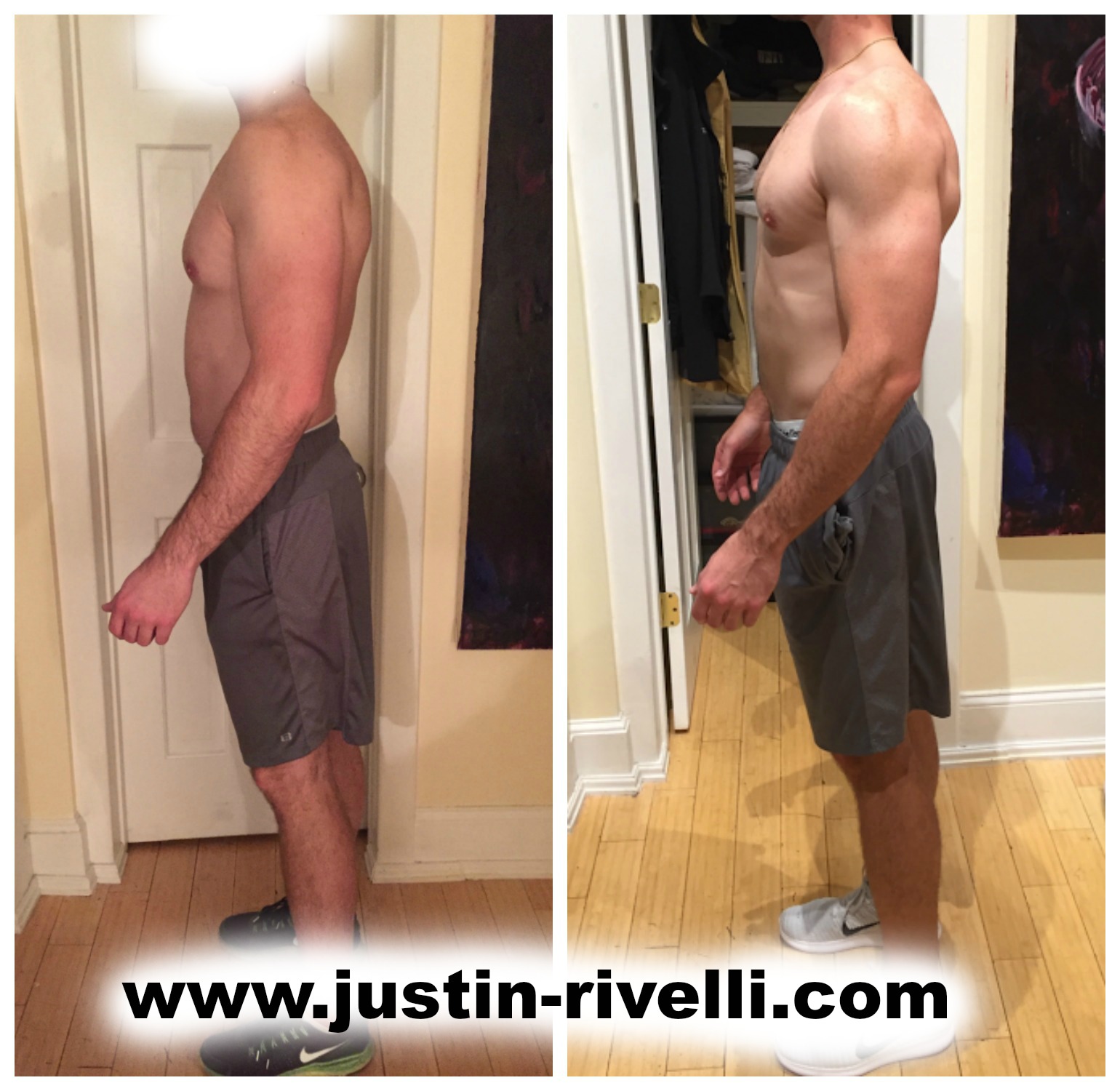
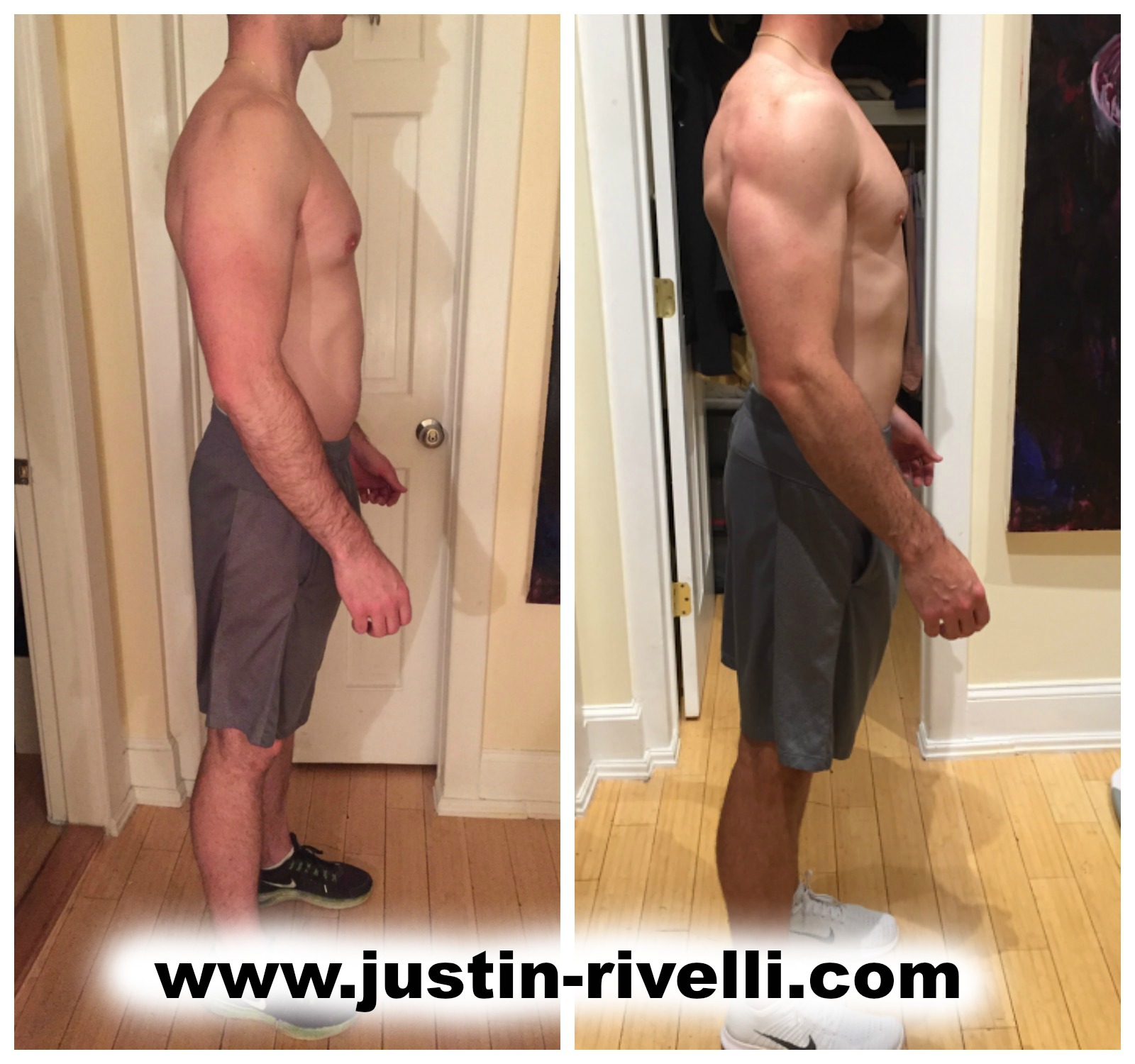
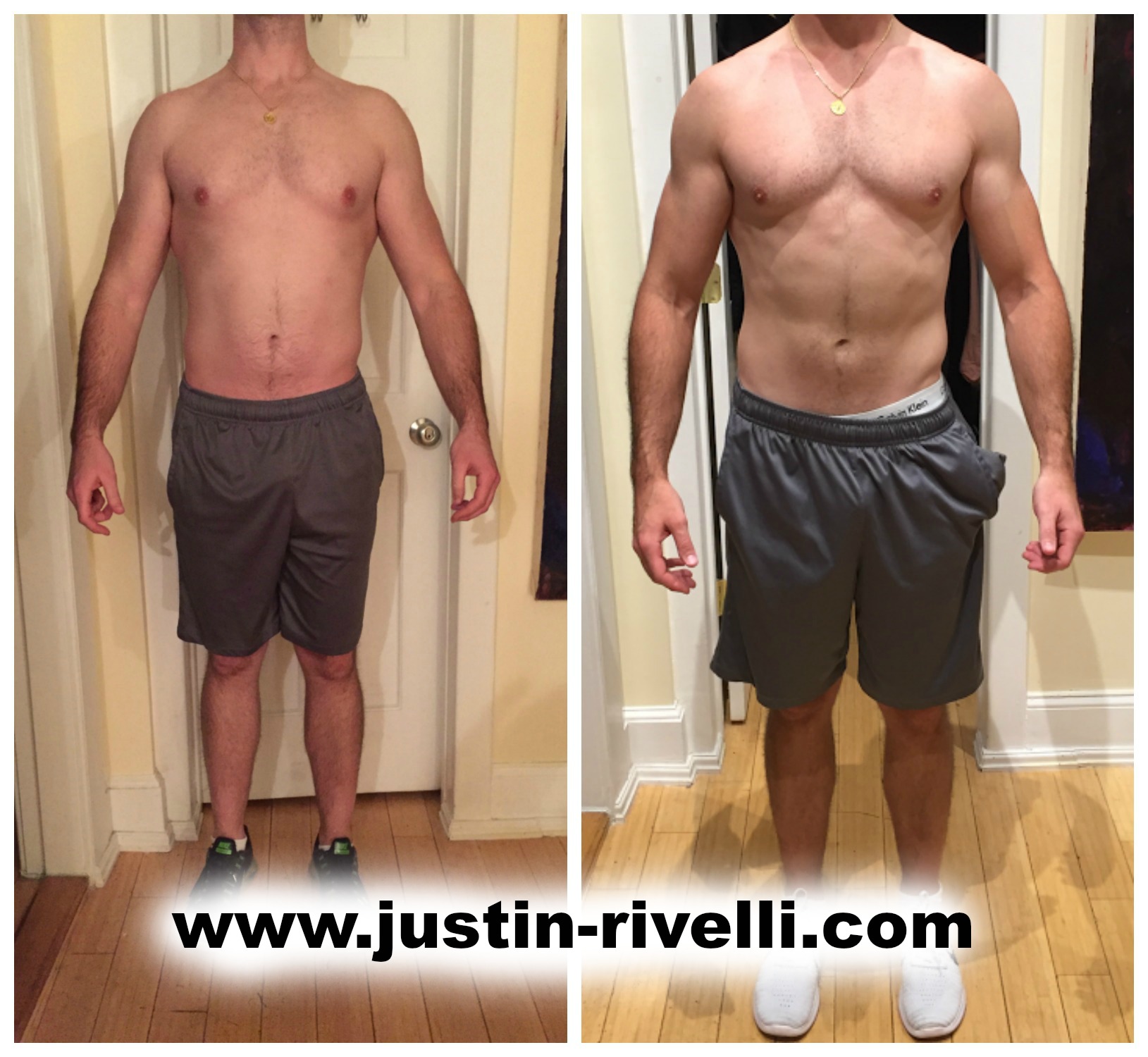
All the clients throughout this article (above and below) are some examples of folks who used resistance training (and the progressive overload principle) in their programs, combined with nutritional changes to get the physique changes shown.
“CARDIO”
The in person and online evaluations I perform, allow me to dive deeply into people’s past current, and possibly future actions, beliefs, and thought processes. This is probably one of my favorite parts of first meeting people, as it allows me to see where their head’s at, and how we can start to solve the issues they can’t seem to themselves.
Before I call, skype, or sit down and talk with someone, I have them fill out a sheet. On this sheet one of the many questions I ask is, “how much “cardio” are you currently performing?” Many times, the answer of people who desire body fat reduction as their primary goal is, “not as much as I should”.
This tells me that a great number of people have this set of beliefs that traditional cardio is an obligation, a duty, and it’s required for fat loss. However, you’ve already found out from point numbers one and two, this simply isn’t true.
Additionally, when it comes to body fat reduction specifically, the energy cost of certain physical activities like “traditional cardio”, don’t elicit as much energy expenditure as many people believe.
For example (Wilkin et al. 2012) compared females 19 to 24 years old, 5’2’’ to 5’9’’, 118 to 195 pounds, and showed they burned anywhere from 70 to 108 calories walking a mile, and 88 to 137 calories running a mile. That’s about equivalent to…
10 to 20 almonds (70-140 calories)
A half of a medium sized skinless boneless chicken breast (140 calories)
A half cup of rice (120 calories)
Less than 1 can of beer (150 calories) or 5 oz of wine (120 calories)
This isn’t to say that “cardio” doesn’t have other benefits, but that it typically doesn’t “burn” as many calories as most folks might think. It’s also not as necessary for a great deal of people as they feel is true.
The takeaway:
When it comes to body fat reduction specifically, cardio can help you expend more energy but it will not result in the same physique changes of more lean muscle mass and less body fat, that proper resistance training can. It will also take longer to do so.
Mistake Number Four: Not Understanding How to Track Progress | Body Weight Fluctuations
There are many reasons besides an increase or decrease in body fat, that your bodyweight goes up and down daily, weekly, and monthly you’re probably not aware of. This can be extremely discouraging, or temporarily exciting, which can cause crowds of people to quit the training and nutrition programs they’re following.
For instance, an upward shift in fluid balance (not fat gain) can mask your body fat reduction results by causing the scale to rise, and make it appear as if nothing is happening when your program is working as it should. On the other hand, a downward shift in fluid balance (not fat loss) can make it appear as if you’re getting leaner when you may just be dehydrated or have an empty bladder.
With that said, I’m going to explain some other ways you can track your fat loss progress, as well as help you understand why bodyweight fluctuations may occur, so it’s less of an issue in the future.
Here are some reasons your body weight can go up or down, that has nothing to do with actual fat loss or fat gain.
A change in carbohydrate intake: When carbohydrates get stored within the muscle they hold 2.7 grams of water per gram of glycogen. 8
Hydration level.
Alcohol consumption: You can wake up weighing less after a night of drinking because of dehydration.
A change your body’s electrolyte balance: Can cause an increase or decrease fluid retention.
Elevations or declines in cortisol: In excess, cortisol has aldosterone-like effects in the kidney causing water retention.
Creatine supplementation: Can increase total body water.
Alimentary tract content
Sleep: Moisture lost when breathing.
Perspiration: Sweating
Certain medications, hormones, and other performancing enhancing drugs.
Herbal cleanses, colon flushes, and diuretics.
A gain or loss of muscle.
Menstrual cycle : Can influence body fluid balance at different phases (menstrual, follicular, ovulatory, luteal).
As you can see from above, this is why using other methods of tracking progress (besides bodyweight) like taking pictures and girth measurements can also come in handy. To boot, most people can consistently replicate, afford, and perform these whenever necessary.
THREE “FRUSTRATING FAT LOSS” CLIENT EXAMPLES | LESSONS I WANT YOU TO LEARN
Here are three real life examples that show how disheartening it can be if you only measure progress by the scale, do not understand what your program is supposed to be doing, and why bodyweight fluctuations may occur.
Client Example Number One | Elena
Surprisingly, even females as consistent as Elena will sometimes go three, four, or five weeks with no change in bodyweight when “dieting”. Then “all of a sudden” they will drop anywhere from four to five pounds over the course of the fifth and sixth week. This can cause a large number of people to lose confidence, enthusiasm, or give up early, when in the end, progress goes as planned by the end of the month.
Here is the exact progression of her bodyweight before her last bikini competition so you can see what I mean. This was with no change in calories, macronutrients (carbohydrates, protein, and fats), or anything else training or nutrition related (sets, rest time, cardio, sodium, or fluid intake etc.) over the course of the six weeks. Her weight is listed in pounds.
Week One: Day 1 – 137.4 lbs Day 2 – 137.4 Day 3- 137.4 Day 4 – 137.2 Day 5 – 137.4 Day 6 – 136.8Day 7 – 137.4 Week Two: Day 1 – 137.4 Day 2 – 137.4 Day 3- 137.2 Day 4 – 137.2 Day 5 – 137 Day 6 – 137 Day 7 – 137 Week Three: Day 1 – 136 Day 2 – 136.5 Day 3 (menses) – 137.5 Day 4 – 137.5 Day 5 – N/A Day 6 – 136.6 Day 7 – 136.2 Week Four: Day 1 – 136.2 Day 2 – 136 Day 3 – 135.2 Day 4 – 134.8 Day 5 – 134.8 Day 6 – 134 Day 7 – 136.4 Week Five: Day 1 – 133.6 Day 2 – 133.8 Day 3 – 134.6 Day 4 – 133.8 Day 5 – 132.6 Day 6 – 133.4 Day 7 – 132.8 Week Six: Day 1 – 133.6 Day 2 – 132.2 Day 3 – 131.4 Day 4 – 132.2 Day 5 – 132.4 Day 6 – N/A Day 7 – 131
The Takeaway:
To reiterate my point, I have bolded in red how the scale showed just about the same exact number after four weeks of dieting.
You can see how easy it would have been to either alter her diet, increase activity, or even quit over the first four weeks of starting a diet when it wasn’t necessary.
If she didn’t take her body weight everyday, and weighed in only once a week, her mindset and data would be skewed.
Client Example Number Two | Ed
Take a look at the numbered arrows….
Ed’s body weight changed just six times over the course of 14 weeks.
With that said, he still lost 11 pounds and even emailed me mentioning it is the most muscular and vascular he has ever been.
Again, even with men, only weighing in one day a week can cause your bodyweight progress tracking to be skewed and defeating.
Client Example Number Three | Amber
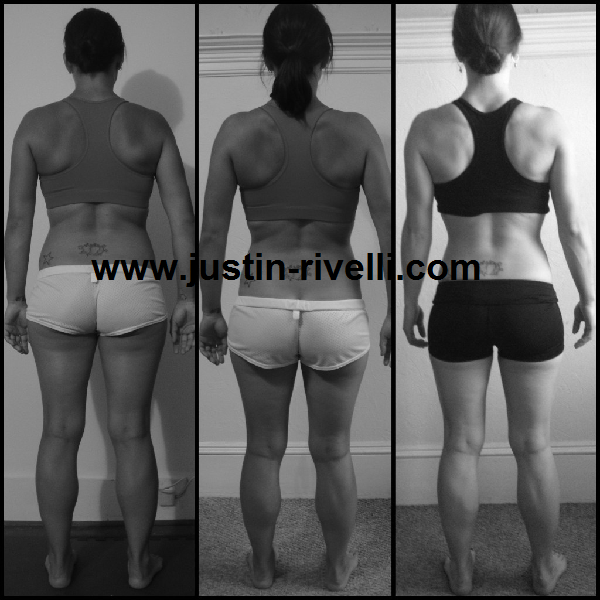
Amber weighs 130 lbs in all three of the pictures above. However, if she didn’t capture images for progress, she may not have realized the physical changes (gain of muscle and loss of fat) that took place over the course of one year.
How Anyone Can Track Progress in a Repeatable, Affordable, and Simple Way
BODYWEIGHT
Record your bodyweight everyday, upon waking, on an empty stomach. Use the same scale, in the same location, preferably naked. Go to the bathroom first if you can.
Over the course of the each week, take the average from your daily bodyweight measurements, so that you’re documenting a seven day moving average.
Compare the average of your bodyweight from week one, to the average of your bodyweight from week two and so on. Refer to the excel document under client example number two for an example.
Notes…
The trend of your bodyweight over time, is much more important than a single measurement. Even (Hall et al. 2012) explains body weight over a day, and between days, fluctuates unrelated to changes in energy stores because of changes in hydration and alimentary tract content, which are the primary contributors to the typical 1–2-lb day-to-day fluctuations in weight.
If you’re a female, be aware of which phase of the menstrual cycle you’re at, as the hormonal changes across it can cause shifts in water balance (Pascale Mutti Tacani et al 2015)
Even with everything set up “perfectly” according to your goals, bodyweight loss is often non-linear. As you can see from above, and also from things like the Minnesota Starvation Experiment, a period of activity or decrease in bodyweight, is usually followed by a state of little or no change.
GIRTH MEASUREMENTS
Equipment required:
Most of you will want to get a flexible tape measure that measures in both inches and centimeters, and that is at least 152 centimeters or 60 inches in length. The official MyoTape tape measure is a great tool for self assessment.
Procedure:
Make sure the tape is lying flat on the skin (not clothing), and is horizontal.
Take 2-3 measurements, and record the average of the measurements within 1 cm.
Take the measurements below on your own, both relaxed and flexed.
Neck (largest girth and below Adam’s apple)
Chest (stay relaxed, taken after normal exhalation)
Two inches above belly button
Two inches below belly button
Around the belly button
Hips (where glutes and buttocks protrude most, widest area)
Right arm (max girth)
Left arm (max girth)
Right forearm (max girth)
Left forearm (max girth)
Right thigh (max girth)
Left thigh (max girth)
Right calf (max girth)
Left calf (max girth)
PICTURES ONCE EVERY FOUR TO SIX WEEKS
Pictures taken every four to six weeks can be extremely motivating and noteworthy. By having these on hand, you will be able to visually see if any changes are happening. It also gives you another piece of objective information to base your assessments off of.
People who do not take these, often regret it. Your mind can play tricks with you, and what you “feel” or see in the mirror can be incorrect or mistaken. Take pictures so you’re not influenced by emotions, opinions, or personal feelings, but rather something that is quantifiable and measurable. Don’t depend on your own personal beliefs. Get real data, and track your results more reliably.
Procedure:
Take the photos showing everything from head to toe.
Stand against a bare uncluttered wall.
Don’t use any filters or added text.
Get images from all angles include front, back, and right and left sides. Feel free to include any additional poses you desire.
Men wear shorts, women wear a sports bra and shorts or a bikini.
Avoid overhead lighting or shadows.
Replicate the same conditions each month (light, time of day, distance away from the camera, clothes worn) as much as possible.
Important notes:
Visual images of yourself, are the absolute best way to measure progress.
They take into account everything whether you know it or not. From waist to hip ratios, to body fat percentage, to level of leanness, to lagging muscles and the like.
They tell us what we look like, which is usually what we’re most interested in, rather than becoming obsessed with numbers and measurements that may not matter (unless you need to make weight for something).
If you’re goal is body fat reduction, and you’re not noticing a change in body weight or girth measurements while adhering to your diet perfectly, pictures will usually help you identify what’s going on. However, by taking them too often, changes in your physique may not be noticeable.
I excluded when it would be necessary to make alterations to any programming, because this is very dependent on the person, goal, and circumstances. I will say that I generally review, analyze, and monitor at least three to four weeks of data (if not more) before making any changes, despite the results or lack thereof.
Crucial notes: If you’re a coach like myself…
This can be annoying to a paying client.
Before you set anyone up on a program, you must clarify what you expect to happen, initial calculations (if necessary), and that as a professional you have their best interest at heart.
Get on the same page as them so they know where you’re coming from, and so that they are willing to tell you the truth about how compliant they are as well. This will help both of you tremendously as time goes on so you’re not just spinning your wheels. When people know what to anticipate, less things will be a problem later on.
Concluding
While the masses are “trying” what’s popular and in style, the people who get results “implement” the fundamental truths of the goal they desire.
There are a countless number of training programs, diets, and supplements that claim to be your body fat reduction “savior”. However, these strategies, concepts, and ideas often point out things you don’t need to know, while failing to provide you with fat loss fundamentals actually required for success.
With that said, there are many ways to approach body fat reduction, as opposed to being confined or married to one particular philosophy. This is why in the end, your goals, lifestyle, environment, behaviors, relationships, tolerances, and preferences, along with many other factors is what will determine the approach that is best for you.
By using the principles above, you are now informed about not only what actually causes weight loss every time, but also with what is to be expected along the way.
If you have any further questions after reading, feel free to post them on my Facebook page here, and I’ll respond to you as soon as possible.
If you want to inquire about customized training and/or nutrition coaching, either online or in person (I’m located in Berkshire County, Ma), you can message me at rivelli.justin@gmail.com.
Contrary to popular belief, metabolic rate (the rate at which metabolism takes place) does not vary much between the majority of the population (Donahoo et al. 2004). However, there is a considerable amount of variability in the number of calories burned per day through non-exercise activity (Levine et al. 2006).
What is non exercise activity thermogenesis (NEAT)? NEAT can be defined as everything we do that’s that is not sleeping, eating or sports-like exercise (Levine 2002). Therefore all physical activities other than intentional exercise like fidgeting, working, ambulating, and playing, fall into this category.
Why is this important? NEAT varies between two people of similar size by up to 2000 kcal day because of people’s different occupations and leisure-time activities (Levine 2007).
Even though NEAT is hard to measure, by becoming aware of it, you may start to recognize how certain amounts of food and training effect either you and/or your clients NEAT. You may also be able to better help them re-engineer their work, school, and home environments as well as make better informed decisions about you and/or your clients current or future programming.
In sum, although many people are quick to judge their “metabolism” when it comes to reducing body fat, an enormous factor that gets left out of the energy balance equation is non exercise activity thermogenesis (NEAT).
If you’re a woman or a coach of one, who’s interested in body fat reduction, and you use the scale as a tool to track progress, it’s important to understand the bodyweight fluctuations that may occur across the menstrual cycle.
Not being educated or aware of the phases (menstrual, follicular, ovulatory, luteal) and the influence of hormonal changes throughout it, can cause monitoring and making fat loss results extremely frustrating and suboptimal.
ONE OF MANY REASONS WOMEN MAY WANT TO GIVE UP
Even if you’re in an energy deficit (what controls weight loss), fluid retention can mask fat loss that’s happening every week, and you might not see a reduction in bodyweight for a month.
Surprisingly, even females as consistent as Elena (in the picture), will sometimes go three, four, or five weeks with no change in bodyweight when “dieting”. Then “all of a sudden”, she/they will drop anywhere from four to five pounds over the course of the fifth and sixth week. In reality, this averages out to about a pound of weight loss each week.
FOR EXAMPLE
Here is the exact progression of her bodyweight before her last bikini competition. This was with no change in calories, macronutrients (carbohydrates, protein, and fats), or anything else training or nutrition related (sets, rest time, cardio, sodium, or fluid intake) over the course of the six weeks. Her weight is also listed in pounds.
Week One: Day 1 – 137.4 lbs Day 2 – 137.4 Day 3- 137.4 Day 4 – 137.2 Day 5 – 137.4 Day 6 – 136.8 Day 7 – 137.4
Week Two: Day 1 – 137.4 Day 2 – 137.4 Day 3- 137.2 Day 4 – 137.2 Day 5 – 137 Day 6 – 137 Day 7 – 137
Week Three: Day 1 – 136 Day 2 – 136.5 Day 3 (menses) – 137.5 Day 4 – 137.5 Day 5 – N/A Day 6 – 136.6 Day 7 – 136.2
Week Four: Day 1 – 136.2 Day 2 – 136 Day 3 – 135.2 Day 4 – 134.8 Day 5 – 134.8 Day 6 – 134 Day 7 – 136.4
Week Five: Day 1 – 133.6 Day 2 – 133.8 Day 3 – 134.6 Day 4 – 133.8 Day 5 – 132.6 Day 6 – 133.4 Day 7 – 132.8
Week Six: Day 1 – 133.6 Day 2 – 132.2 Day 3 – 131.4 Day 4 – 132.2 Day 5 – 132.4 Day 6 – N/A Day 7 – 131
AGAIN I WANT TO EXPLAIN
The above was with no change in calories, macronutrients (carbohydrates, protein, and fats), or anything else training or nutrition related (sets, rest time, cardio, sodium, or fluid manipulation) over the course of the six weeks. However, you can see how easy it would have been to either alter her diet, increase activity, or even quit over this period of time.
THE TAKEAWAY
1. Education of the menstrual cycle, can save many women and coaches a lot of frustration, when it comes to measuring bodyweight changes.
2. You could start a fat loss diet, witness no changes on the scale for a month, when in reality body fat is being lost each week. Daily and weekly bodyweight fluctuations are usually normal.
3. By making adjustments too early, it’s easy to run yourself into the ground, give up, or act like a lunatic (sorry ladies) when really it’s often unnecessary and detrimental.
WHAT YOU SHOULD ALSO KNOW
1. If you don’t understand the“diet” you’re on in the first place, what it is supposed to be doing, or expected outcomes of it, none of this will matter. However, if you do, take note of the shifts in water balance you personally experience.
2. Although I work with a great deal of women who don’t experience “all over the place” bodyweight fluctuations, some of them do.
TO MAKE THIS EVEN MORE COMPLEX
The influences of bodyweight across a woman’s menstrual cycle can vary month to month, and person to person.
MORE INFO
Although I’m only talking about bodyweight specifically in this post, both literature and experience has shown women experience many different changes in things like strength, appetite, energy expenditure and more throughout the cycle as well.
For example, “In the luteal phase of the menstrual cycle it appears that women’s energy intake and energy expenditure are increased and they experience more frequent cravings for foods, particularly those high in carbohydrate and fat, than during the follicular phase.” Davidson L. et.al (2007)
ABOVE ALL ELSE, THIS IS NOT AN EXCUSE
1. This is not an excuse. No matter what bodyweight fluctuations are going on, weight and/or fat loss will occur if you are in a net negative energy balance (consuming fewer calories than your body needs to maintain it’s current weight) each week.
2. Tracking body fat reduction progress for females can be extremely complex. If you’re not being compliant, you have a binging episode, or something else “out of the ordinary” takes place, don’t just say “it’s my menstrual cycle”. This will also save you and your coach a lot of unnecessary stress and adjustments.
3. There are also other reasons scale may go up or down that most people are not aware of. For this reason look at my next post. Therefore it’s often important to use other methods of tracking like pictures, girth measurements, compliance, stress, and sleep etc. (although these can also get skewed) as well.
Educate yourself. Communicate with your coach or client. Recognize there is a tremendous amount of variability between women. Have patience, and trust the system. – Justin
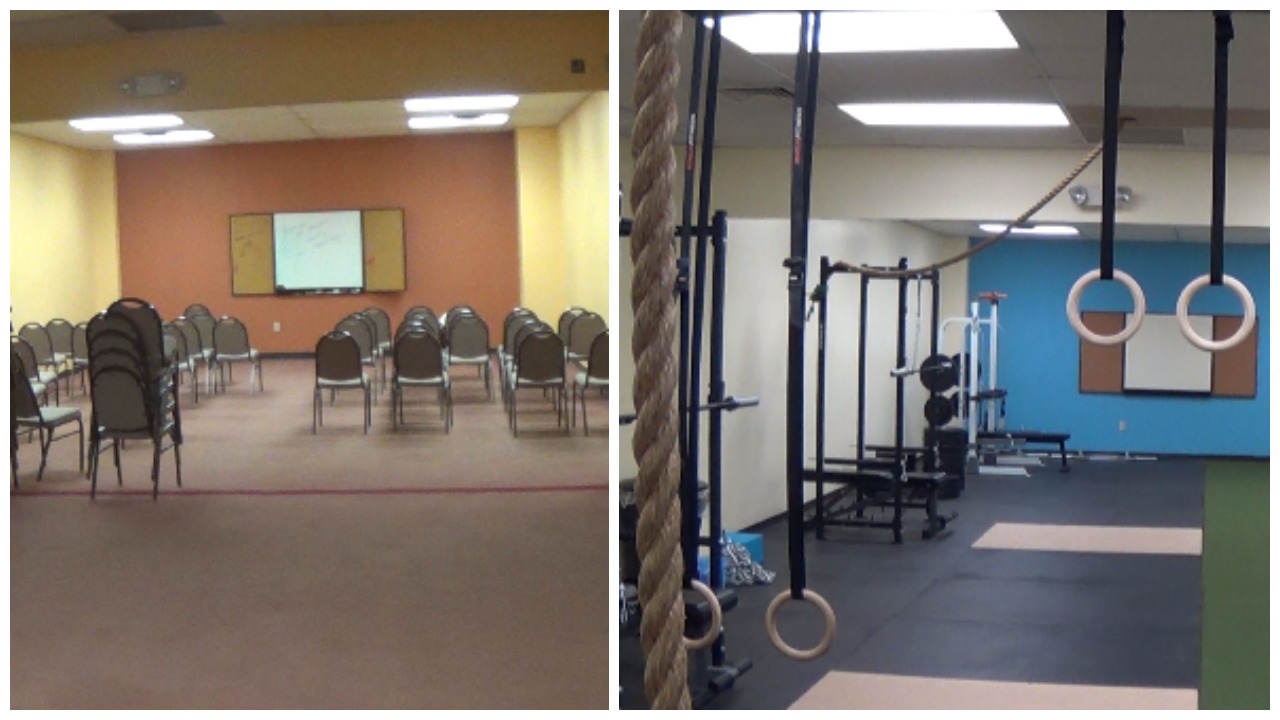
Here’s a quick two minute compilation of some of my in person clients training. Everyone in this video was filmed at the new place I just opened up in Pittsfield Ma. Any questions will be responded to on any of my social media platforms below.
After over nine years of coaching people through training and nutrition programs, more than twelve years of practicing what I preach, and an entire life of wanting to help others, I have reached the point where I am able to do this in any way I choose, on my own terms.
If you’re wondering what this means, it’s that I have recently opened up a local, evidence based, training and nutrition coaching facility in Pittsfield Massachusetts.
Although I didn’t grow up having the same financial support as others around me (this is not a bad thing) I did have the emotional and physical backing of family, clients, friends, and the like.
I told Elena I don’t like writing about myself, so I’m just going to copy and paste a short couple paragraphs she has written below.
“Anyone can have fitness as a hobby, go online, and become an “expert”. With the fitness industry becoming bigger than ever, it seems there are new trainers and facilities popping up everywhere. They typically brag about themselves yet have no real clients, experience, or knowledge. They supply programs and information with no real purpose and just go through the motions. Some even just hop on the current training and diet fads, and their clients never see many results, especially long term.
When I first met Justin over three years ago, I was instantly drawn to his excitement and passion for helping others, and the fact that he had made this his life. I could see the care and special attention he gave to every single person that came to him and how he learned as much about that person as he could by asking for their history, current lifestyle, ultimate goal, and all of the little details, that are important, that most “trainers” skip over. He adjusted to meet the needs of everyone individually and what was going to best suit them to reach their goals.
When he’s not in person coaching his clients, he is glued to his laptop or phone, answering emails from current clients and adjusting programs to give them the best results they can possibly have. His limited “free” time is spent pouring through the latest, evidence based research to truly understand the science behind everything. Justin is much more than a trainer. He is a person who has a true passion for what he does and I’m very honored to be able to see part of his dream be lived out by opening a facility.”
To those reading, all I’m asking, is that you share this post to make people aware I’ve have recently opened up a local training and nutrition, coaching based facility in Berkshire County Massachusetts. If you have any questions about anything just message me. You can see the gym in the video above.
More content that I believe will be valuable to you is coming soon. Thanks for the support!
Here’s a sample, non traditional, training program and template I’ve created. If you receive any benefit from it, all I ask is that you either subscribe or leave a comment on my Youtube channel, like my Facebook page, or comment anywhere letting me know you’ve used this. If you give this a shot or have questions while you’re doing it just let me know. Thank you, and enjoy!
Training Schedule
Monday: Heavy Total Body
Tuesday: Moderate Total Body
Wednesday: Auxiliary Day
Thursday: Off
Friday: Heavy Total Body
Saturday: Moderate Total Body
Sunday: Auxiliary Day
Monday: Off
Monday
A) Heavy squatting/knee dominant/quadriceps movement: Front squats (4×3-6) Rest time: 2-5 minutes
B) Heavy chest movement: Flat Bench Press (4×3-6 reps) Rest time: 2-5 minutes
C) Heavy vertical pull/back movement: Chin ups (4×3-6) Rest time: 2-5 minutes
D1) Light deadlift/hinging/hamstrings movement: Leg curls (2×12-20) Rest time: minimal to none, right into D2)
D2) Light shoulder movement: Rear deltoid raises (2×12-20) Rest time: 1 minute
Tuesday
A) Moderate deadlift/hinging/hamstrings movement: Standing barbell good mornings (3×8-10) Rest time: 2-3 minutes
B) Moderate shoulder movement: Z press (3×8-10) Rest time: 2-3 minutes
C) Moderate back movement: Single arm cable rows or meadows rows (3×8-10) Rest time: 2-3 minutes
D1) Light upper body chest movement: Chest fly’s with manual resistance (2×12-20) Rest time: 45 seconds, then into D2)
D2) Light squatting/knee dominant/quadriceps movement: Leg extensions (2×12-20) Rest time: 45 seconds, then back into D1)
Wednesday
A1) Biceps: Cambered bar biceps curls (hanging plates): 3×5 Rest time: 1 minute then into A2)
A2) Triceps: Cambered bar skull-crushers (hanging plates): 3×8-10 Rest time: 1-2 minutes then back into A1)
B1) Calves: Calf raises (3×12-20) Rest time: Minimal to none, then right into B2)
B2) Anti-rotation core: Split stance cable lifts (3×10) Rest time: 1 minute then back into B1)
C1) Traps: Overhead shrugs (3×8-12) Rest time: Minimal to none, then right into C2)
C2) Hip thrusts (3×15-20) Rest time: 1-2 minutes then back into C1)
D1) Carry variation: Farmers walks with dumbbells (3×40 yards)
Thursday: Off
Friday
A) Heavy deadlift/hinging/hamstrings movement: Trap bar deadlifts (4×3-6) Rest time 2-5 minutes
B) Heavy shoulder movement: Barbell Press (4×3-6) Rest time 2-5 minutes
C) Heavy horizontal pull back movement: One arm dumbbell rows (4×3-6) Rest time 2-3 minutes
D1) Light upper body chest movement: Chest fly’s (2×12-20) Rest time: 1-2 minutes
D2) Light squatting/knee dominant/quadriceps movement: Leg curls (2×12-20) Rest time: 1-2 minutes
Saturday
A) Moderating squatting/knee dominant/quadriceps movement: Rear leg elevated split squats with dumbbells (3×8-10) Rest time: 2-3 minutes
B) Moderate chest movement: Incline dumbbell bench press (3×8-10) Rest time: 2-3 minutes
C) Moderate back movement: Kneeling x lat pulldowns (3×8-10) Rest time: 2-3 minutes
D1) Light deadlift/hinging/hamstrings movement: Back extensions (2×12-20) Rest time: Minimal to none, right into D2)
D2) Light shoulder movement: Rear delt raises (2×12-20) Rest time: 1 minute
Sunday
A1) Dumbbell hammer curls: 3×8-10 Rest time: 1 minute then into A2)
A2) Triceps extensions or dips: 3×5 Rest time: 2 minutes then back into A1)
B1) Seated calf raises (2×12-20) Rest time: Minimal to none, then right into B2)
B2) Anti rotation core: (2×10) Rest time: 1 minute then back into B1)
C1) Traps: Overhead shrugs (3×8-12) Rest time: Minimal to none, then right into C2)
C2) Hip thrusts (3×15-20) Rest time: 1-2 minutes then back into A1)
D1) Carry variation: Farmers walks with dumbbells (3×40 yards)