Since I’ve been staying more up to date with Youtube, Instagram, and Facebook posts, I figured I would start placing that exact content here as well. The reason for this, is that I believe will be of great value to you. Any questions, concerns, or comments just ask and I’ll get back to you as soon as possible.
A1) Goblet squats: Great for teaching and grooving good squat technique, while at the same time delivering a training effect to the quadriceps, core, and upper back.
A2) Prone scapular swimmers: For improved mobility, articular strength, and neurological control. “In the process of developing mobility, all articular connective tissue components are strengthened, and neurological control of said tissues enhanced. These are two factors well known in the scientific literature to enhance joint health, prevent injury, and improve longevity”. – Dr Andreo Spina. For more information about these principles check out @drandreospina.
A3) Single arm cable rows: Used for general upper body pulling/back strength, and for training things like the lats, rhomboids, and lower and middle traps.
B1) Kettlebell deadlifts: To engrain the hip hinge pattern, improve hip extensor strength, and to further develop the glutes, hamstrings, and lower back.
B2) Push ups: To develop upper body strength while integrating the core and lower body.
C1) Plate push conditioning circuit: To improve total body conditioning, endurance, and to increase mental toughness while pushing from a plank position.
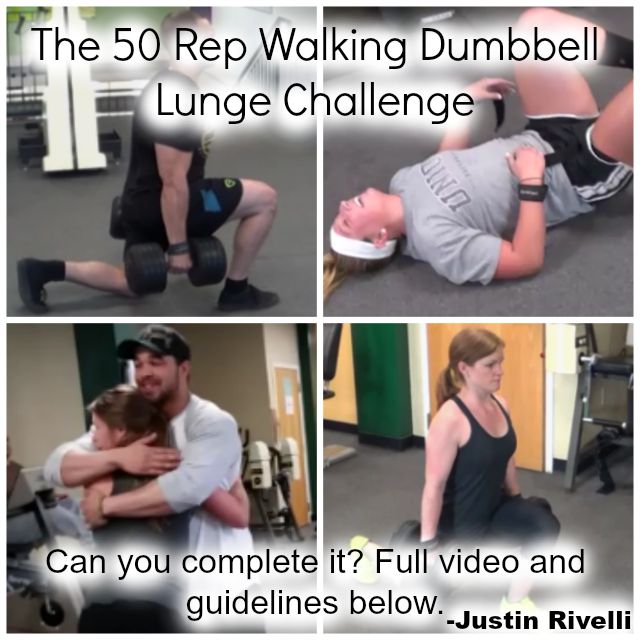
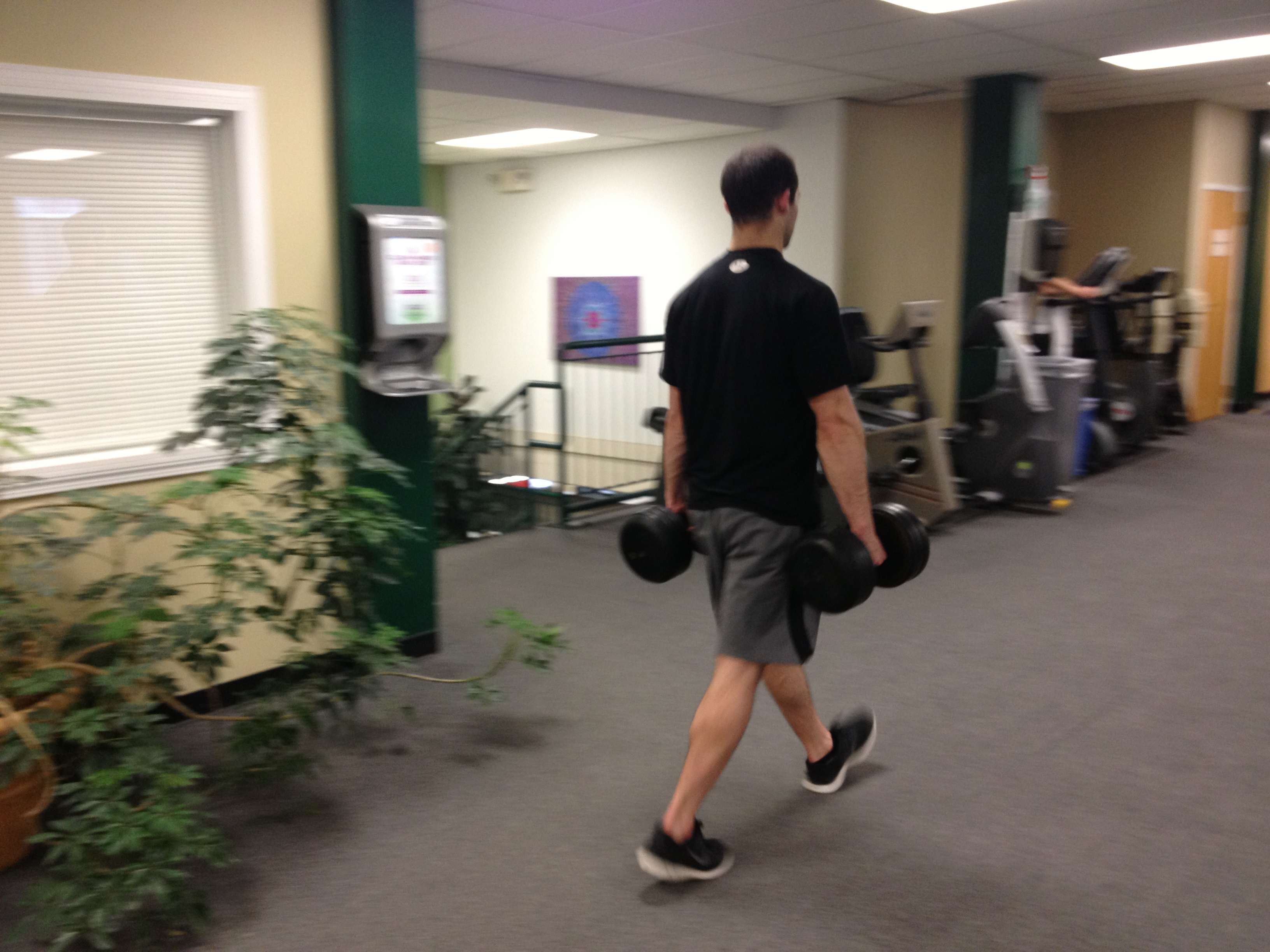
Females: You must use a total of half of your bodyweight (in lbs) with dumbbells . For example, someone who weighs 140 lbs, would use 35 lb dumbbells in each hand.
Males: You must use a total of 70% of your bodyweight (in lbs) with dumbbells . For example, someone who weighs 185 lbs, would use 65 lb dumbbells in each hand.
Ground Rules:
You will be disqualified if you drop the dumbbells, and/or fall over.
You can rest as long as you want, however the weights must stay in your hands, and you must remain standing on two feet.
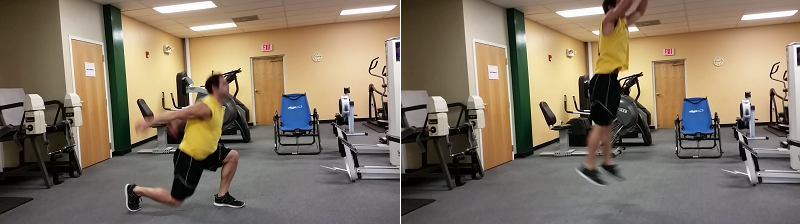
Your back knee has to make contact with the ground with each step, otherwise the rep doesn’t count.
Notes:
Straps are allowed.
You can “step too” or “step through” when lunging.
The stride length of each step doesn’t matter. You can use a short, moderate or long step.
If you’re willing and able, try this yourself and let me know how you did in the comments sections on my Facebook page. I hope you liked the video, and thanks for watching!
I decided to take a different approach to get my point across with this video. If you like it, let me know on my YouTube channel or Facebook page. I hope you laugh, learn, and get thinking because of this film. I appreciate you watching!
It was awesome to see how many local gym enthusiasts and friends performed my twelve week body composition training program. This inspired me to put out a a full video series with voice-over, along with a documented description of my recent training for you as well.
If you want to see some strength and body composition improvements, give the system below a shot. If you have any questions at all comment below, however I do explain more in the videos as well.
Lower Body Day One
A1) Vertical tuck jumps
Week 1: (3×3) Week 2: (5×3) Week 3: (3×5) Week 4: (5×5)
Rest time between sets: 30 seconds
B1) Front squats
Week 1: (3×5) Week 2: (5×5) Week 3: (3×3) Week 4: (5×3)
Rest time between sets: 120-150 seconds
C1) Two position paused front squats
Weeks 1 and 2: Two position eccentric paused front squats (pause once at the bottom, and another at your sticking point)
Weeks 3 and 4: Two position concentric paused front squats (pause once at the bottom, and another at your sticking point)
Week 1: (3×3) Week 2: (3×4) Week 3: (5×3) Week 4: (6×3)
Rest time between sets: 90-120 seconds
Week 1: (2 x failure) Week 2: (3 x failure) Week 3: (4 x failure) Week 4: (1 x failure)
Go through all the “D” exercises with no rest. Then rest 90 seconds after each round is completed.
Upper Body Day One
A) Overhead barbell press
Week 1: (3×4) Week 2: (3×5) Week 3: (3×6) Week 4: (3×7)
Rest time between sets: 120-150 seconds
B1) Lat pulldowns
(3×8-10) Progressively add weight each week you are able. Once you can get 3 sets of 8 move up the weight. Then do not increase again until you can perform 3×8.
Rest time: None, right into B2)
B2) Push ups (with added ROM and resistance)
Week 1: (3×8) Week 2: (4×8) Week 3: (3×6) Week 4: (4×6)
Rest time: 90 seconds, then back into B1)
C1) Suspended chest fly’s
Week 1: (2×6-8) Week 2: (3×6-8) Week 3: (2×8-10) Week 4: (4×8-10)
Rest time: None, right into C2.
C2) Lying dumbbell triceps extensions
Week 1: (3×6-8) Week 2: (3×6-8) Week 3: (3×8-10) Week 4: (3×8-10)
Rest time: 90 seconds, then back into C1.
D1) Plate grip shrugs
(3×8 w/2 second hold at peak contraction of each rep) Progressively add weight each week you are able. Once you can get 3 sets of 8 move up the weight. Then do not increase again until you can perform 3×8.
Rest time between sets: 60 seconds
I also did about 10-20 handstand push ups throughout the day as well.
Lower Body Day Two:
A) One Step Vertical Jumps
Week 1-5: (3×3-5)
Rest time between sets: 30 seconds
B) Hang Power Clean or Hand Power Snatch
Week 1: (3×5) Week 2: (5×3) Week 3: (3×5) Week 4: (5×3)
Rest time between sets: 120 seconds
C) Deadlift
Week 1: (1×5) Week 2: (1×3) Week 3: (1×3) Week 4: (1×3)
Rest time between warm up sets: As needed
D1) KB swings
Week 1: (3×15) Week 2: (2×20) Week 3: (2×25) Week 4: (2×30)
Rest time between sets: 45-60 seconds
D2) Seated calf raises
Week 1: (2×15) Week 2: (2×20) Week 3: (3×15) Week 4: (3×20)
Rest time between sets: None, right into D2.
E) Ab wheel rollouts (8-12)
Rest time between sets: 45 seconds
Upper Body Day Two:
A1) Z Press
(3×8/side) Progressively add weight each week you are able. Once you can get 3 sets of 8 move up the weight. Then do not increase again until you can perform 3×8.
Rest time between sets: 120 seconds
B1) Chin ups
(3×8) Try to get one more rep each week, on at least one set, each week.
Rest time between sets: None, right into B2.
B2) Slight incline dumbbell bench press
Week 1: (3×4) Week 2: (3×5) Week 3: (3×6) Week 4: (3×7)
Rest time between sets: 90-120 seconds
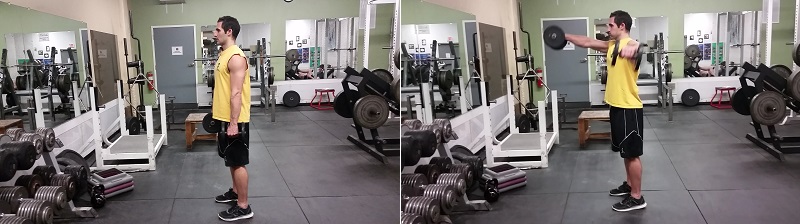
C1) Landmine lateral raises
(3×8) Try to add one more rep, each set, each week.
Rest time between sets: None, right into C2.
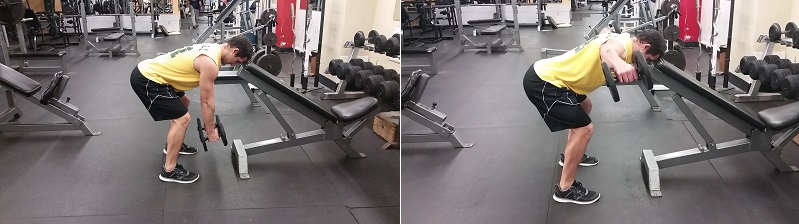
C2) Bent over dumbbell row
(3×5 w/4 second hold at peak contraction of each rep)
Rest time between sets: 60-90 seconds.
D1) Inclined dumbbell biceps curls
(3×6) Rest time between sets: 60-90 seconds.
Progressively add weight each week you are able. Once you can get 3 sets of 6 move up the weight. Then do not increase again until you can perform 3×8.
Day Five: Total Body Power:
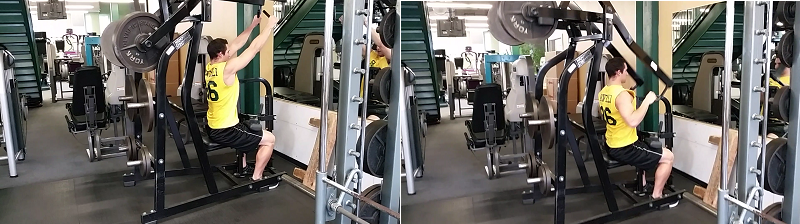
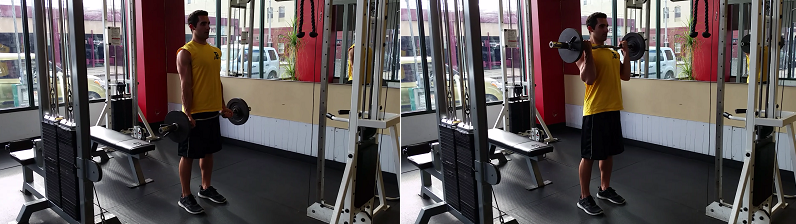
A1) Suspended reverse flys x 12 A2) Heidens x 5/side A3) Explosive push ups x 5-10 A4) MB slams x 10 A5) Farmers Walks x 40 yards
Week 1: 3 rounds (30 seconds rest between exercises) Week 2: 4 rounds (30 seconds rest between exercises) Week 3: 3 rounds (minimal to no rest between exercises) Week 4: 4 rounds (Minimal to no rest between exercises) With each week rest 90-120 seconds after each circuit is completed, and then repeat for the prescribed number of rounds.
If you liked this post, please like it, share, or subscribe.Also, don’t forget to check out my YouTube channel here if you haven’t done so already. You can also leave a response below, or comment on my Facebook page here, with any questions or concerns you have regarding this piece.
For those of you that like watching instead of reading, you can view the video below…
https://www.youtube.com/watch?v=EiKHH8BD27A
The Disappointment.
Six months ago I performed a fifty rep back squat challenge with my body weight on the bar. Spoiler alert…I failed miserably.
The problem was, at around rep 17 my lower back was toast. When I got to number 20, I pretty much collapsed. Despite all this, I somehow managed to grind out a total of 24 reps.
It wasn’t my legs that couldn’t finish the set, but rather my lower back was the limiting factor. It tightened up to the point where I just couldn’t handle the bar on my back any longer.
Meanwhile, my girlfriend completed 50 reps with 95 pounds right before me as she laughed and said, “I did it, why couldn’t you?”
With my competitive nature, I didn’t state how she attempted this with less than her body weight on the bar (or did I), but instead became determined to find a solution to the “issue” I was having.
Note: I tried this again the next week, and the same exact thing happened. I tried it again two weeks later and confirmed this wasn’t a one time occurrence.
The Self Experiment.
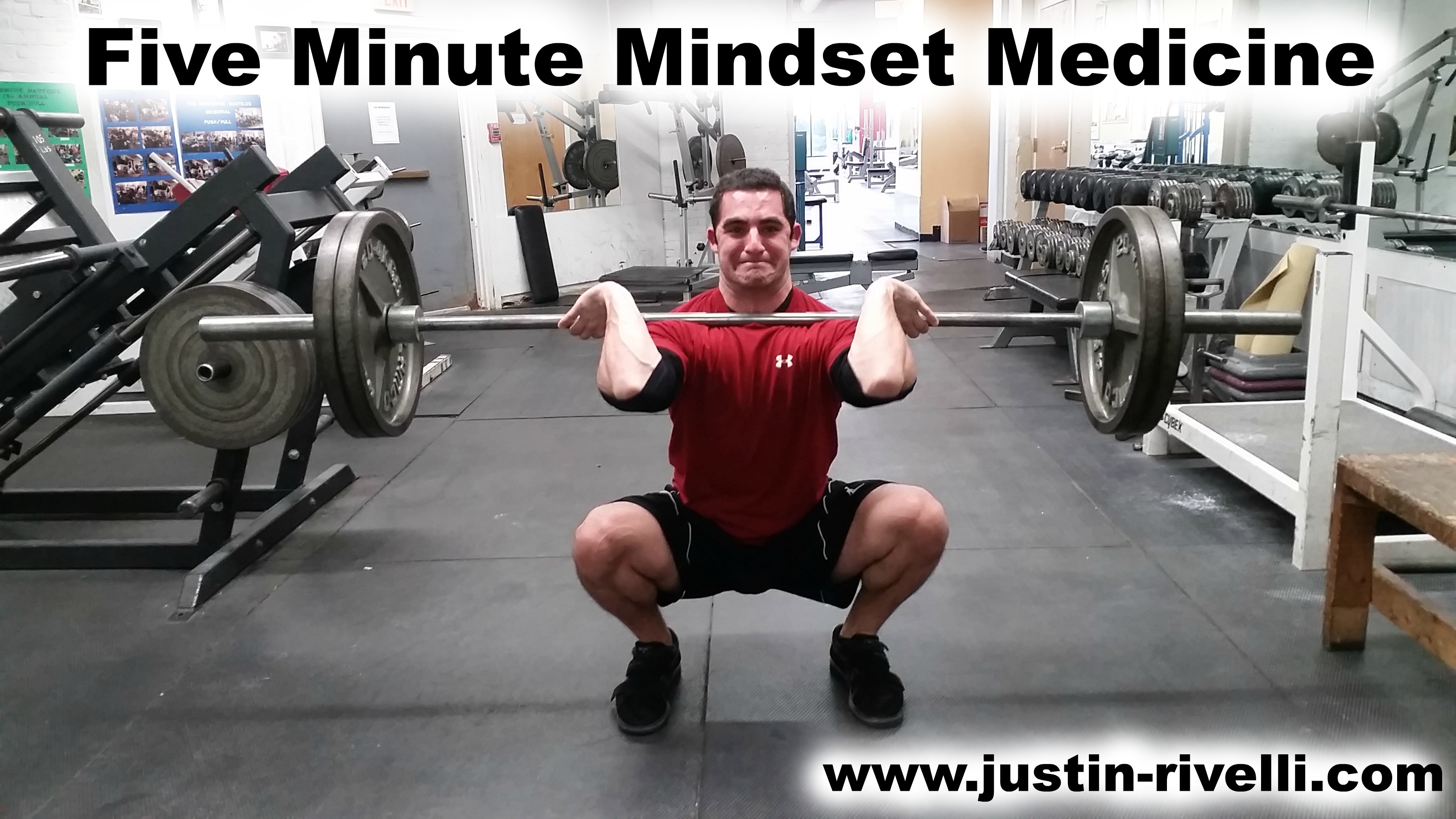
I decided I was going to take a break from back squats and implement front squats at least two days a week.
Over this time, one day consisted of sets in the 1-5 rep range, and the other consisted of all sorts of tempos, pauses, and/or reps in the 6-15 rep range. There were also periods where I mixed these days together as well. I did this for six months.
Again to reiterate, I took 6 months off of back squatting, with most other parameters staying constant.
What Happened.
Six months passed, and I was ready to step back under the bar and back squat. I was nervous the weight was going to either one, cause me some difficulties, or two, feel extremely heavy.
As I took my first warm up set, the bar felt a bit unstable. But after rep number one, I was like whoa!
It was probably the best feeling back squat I have ever performed in my entire training career, which is over 10 years.
However, Before Re-attempting The Challenge…
I wanted to give myself some time to adjust to back squatting again. Here is what I did…
Sunday, the first day back of executing back squats, I got exited they felt so good and worked up to a one rep max. Like I mentioned earlier, the warm up sets felt great. But since I hadn’t put that much weight on my back in a while, the heavier back squats didn’t feel nearly as light as I had hoped.
Wednesday, three days later, I performed a couple ten rep sets, which felt fantastic.
The Sunday following, I completed a couple six rep sets. These also felt pretty good.
All of these are in the video I posted at the beginning of the article.
Did I now complete the challenge?
If you wish, check out the video above to find out!
Here’s A Quick Background Of Myself Before I Wrap Things Up.
I have strong lockouts with deadlift and hip hinge variations, but struggle the most with initially getting weight off the floor.
I used to have some slight lumbar flexion at the bottom of my back squat, with or without weightlifting shoes. This would occur even I when I would break at the knees first, not send my hips back as much, and remain more upright.
Despite taking big breath of air in through my entire “core” (front, sides, and back), getting tight everywhere (lats included), and forcing my knees out, my lower back would still round a bit at the bottom of the back squat. I’m not saying whether this is good or bad.
I have always been able to front squat more than 80% of what I can back squat.
My hips would not rise up faster than my torso, even while using loads at 90% of my max or more during the back squat.
I was wearing my weightlifting shoes (elevated heel) over the last six months, more than I ever have.
What I Think Could Have Been “Wrong” For Those Interested.
My lower back previously went through through more flexion/extension during this lift, and was therefore more active.
My glutes and hamstrings used to do more of the work, with my quadriceps being less involved than they are now.
My spinal erectors may have been weak in this situation.
I might have been weak in other muscles, causing my lower back to compensate and take more of the stress.
I don’t believe my quadriceps were weak, however by wearing my weightlifting shoes more often (elevated heels), it may have generated less use of my spinal erectors, and more activation of my legs/quadriceps when squatting.
Contrary to popular belief, I do not believe my lower back tightening up was a nutritional issue (hydration or electrolyte imbalance etc.) as a lot of new research suggests this is unlikely.
Additional Notes:
I never used to get sore in my quadriceps, but now I do almost every time I back squat. My quadriceps were absolutely demolished after that challenge. When I say that, I mean they were destroyed for five days, with the soreness finally going away on day seven or eight.
Wrapping Things Up.
I didn’t post this material as a solution to improve your back squat. Instead, this article was meant to serve you in a way that you may find entertaining, useful, or informative. Information like this is going to greatly depend on each person individually, your goals, technique, body structure, injury history and much more.
Furthermore, I recognize it may not have been the front squats alone that helped me, however I do believe they served as a huge contributor when looking at the big picture.
If you’re willing to give it a shot, please comment and let me know how it goes. I would be interested to see how you respond to doing so.
If you liked this post, please like it, share, or subscribe. Also, don’t forget to check out my YouTube channel here if you haven’t done so already. You can also leave a response below, or comment on my Facebook page here, with any questions or concerns you have regarding this piece.
Since Elena and I have been training together over the last three weeks, I decided to film our sessions and provide you with some commentary. In the videos below you will both see and hear about…
1. The programs were following.
2. The parameters and differences between them.
3. Why we’re using this system.
We also came across some weird little encounters and add in some surprises/entertainment in some of these videos as well. If you have any questions scroll tot he bottom of this page.
I hope this information is useful, and thanks for watching. If you liked this post, please like it, share, or subscribe. You can also leave a response below, or comment on my Facebook page here, with any questions or concerns you have regarding this piece!
When listening to an audio tape, I once heard Brian Tracy explain “The Rule of Three”. This strategy is used to teach business owners how to maximize their priorities. Throughout this post, I have transformed and expanded this concept in a way I believe can greatly benefit people looking to improve their fitness.My words don’t represent him, but I wanted to give credit where it’s due.
In this article you will learn…
There are a countless amount of things you can do that will help you achieve your fitness goals. However, only a select few of them will account for the majority of your results. The rest of your actions won’t generally matter.
Today I’m going to give you a simple guide on how to both choose, and execute, what is most important when it comes to attaining your desired outcome. This will also help you filter out engagements that are of little to no significance or value.
By answering the three questions below, you will discover what you must do, in order to acquire the success you yearn for. Without knowing or applying the answers, you will not receive results. That is, unless you implement them unintentionally or accidentally.
Here we go…
1. If you could only pick one activity to perform, which single achievement would have the absolute greatest effect on the results you desire?
By way of illustration, let’s say you want to gain lean muscle tissue.
In this situation, you must put at least some type of stress on your muscles to generate muscular hypertrophy or growth. How you do this, is going to depend on a multitude of factors. Nonetheless your goal will not be achieved in absence of this one action.
My point is, your response to this question should simply stick out like a sore thumb. If you are the slightest bit unsure of what this is, do whatever is necessary to find the answer. This will be the factor that determines whether you will succeed or fail.
2. If you could only pick two activities to perform, which second achievement would have the absolute greatest effect on the results you desire?
If we stick with our scenario from question one above; we understand that first and foremost, you must apply some type of stress to the body for muscular adaptations, hypertrophy, or growth to occur. Nonetheless, how you decide to do so, is up to you.
Keeping things simple, let’s assume you decide to start working out. Along with this, your schedule allows you to attend the gym three days week, for forty five minutes each appearance.On the left hand, you spend the majority of your time performing movements that expend little amounts of energy like calf-raises, triceps extensions, and side raises. On the right hand, you opt to execute movements like lunges, squats, and push-ups, where you will expend greater amounts of energy.
In this scenario, the right hand’s conditions provide you with more suitable behaviors, that give you more bang for your buck. Partaking in anything is great, but if you go with the left hand’s philosophy, generally speaking it’s not optimal according to your original goal. Time and energy could be better spent elsewhere.
In the end, question two will direct you towards a more appropriate solution, so you are achieving maximum productivity, with minimum wasted effort or expense.
3. If you could only pick three activities to perform, which third achievement would have the absolute greatest effect on the results you desire?
I could go on an on with this list of questions, asking you what is the fourth, fifth, and sixth etc. achievement that would have the greatest effect on the results you desire, but by now I’m sure you get the picture.
The overflow of information, pouring in and out of the fitness industry, generates a lot of confusion about what you should and shouldn’t do to reach your goals. By asking these three questions, you cut out the hogwash, and put the more meaningful, worthy, and useful information into practice. All other actions can be sorted out, completed afterwards, or left undone.
Just because there are multiple ways to do things, doesn’t mean you should carry out every which way. The answers to these three questions put the focus on chief principles, while getting rid of the unnecessary tasks, that award you with minimal to no results.
Most individuals who acquire the success they want, tend to apply this material automatically, whether they know it or not. Give yourself a kick in the butt, make a list of things you need to do, and execute the three that are most critical. It doesn’t hurt to remind yourself of what’s most important, and by doing so you will achieve results the greater number of the population only wish they could.
Why are we amazed when some people do things, but turned off when so many others perform that same activity?
What you implement is important. It’s a decisive factor in determining whether you will receive a magnificent or skunky outcome. Nonetheless, if how you perform that something is lousy, receiving jaw-dropping results is most likely doubtful.
How you do what you do can bring either total success, or total failure.
Below are three quick examples before I dive into a fitness illustration.
Most people have the ability to talk. Be that as it may, how you say words, i.e. seriously, or with a sarcastic remark, can draw out totally different consequences.
Numerous amounts of people drive on the daily. But how they operate and control the direction and speed of their motor vehicle will either send them to their destination, or into an accident.
For number three I want you to think of an example of your own. What might not matter, if you’re how is inadequate? Keep it PG.
The how increases the quality and value of what we do.
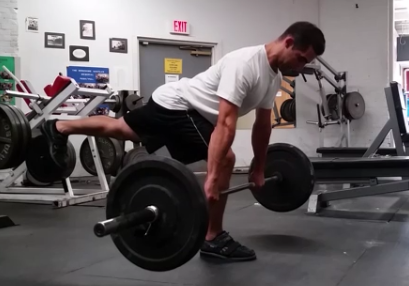
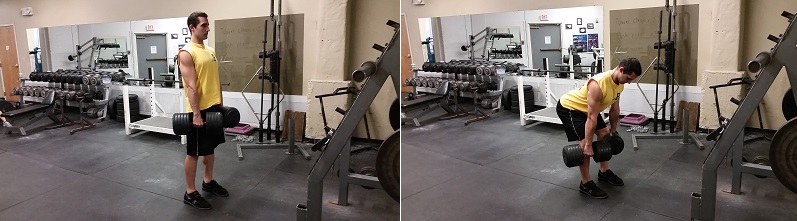
For instance, imagine you strongly desire to increase the size of your glutes. If you’re a male, you wish to appear more powerful, and if you’re a female, you want to fill out your back pockets and look curvy. You’ve done some research on what exercises to implement, and have chosen to perform Romanian deadlifts (RDL’s).
If you apply the exercises in this manner, it allows you to stimulate and feel your buttocks working intensely. If you can’t spot this, my glutes are rock solid in the picture below on the right.
However, if you execute them in ways like this, you completely ignore putting tension on your tush, the exact musculature you have intended too. Observe the arched lower back and relaxed glutes in the picture below on the right.
You see, even after finding out what exercises to complete, how you execute them can make or break your results. You could perform all the RDL’s in the world, but if you are not applying them accordingly, you will barely stimulate what you desire.
On a side note, I’m not saying it’s wrong to neglect your glutes or anything else, especially if you’re doing so for a reason. However, if you’re primary goal is being omitted; your success will be as well.
That’s just one scenario, but my point is, what you’re doing may not even matter if your how is inadequate.
What activities people engage in, usually aren’t that different. They are familiar to us. How they are performed, is what separates unsatisfactory, from extremely impressive outcomes.
There are countless amounts of people that train every day. What types of movements they carry out, like squats, push-ups, pull ups, etc., are often very similar, but how they are conduct them, might not be.
Despite the fact that what is necessary, in the absence of how, the awesome results you’re expecting aren’t as likely. In other words, although what you’re doing is a critical piece of the puzzle, without learning the how, you may be selling yourself short.
This post isn’t meant to scare you away from taking action. Instead it says once you find out what you should be doing, learn how to do it in a way that will be most beneficial to you.
This is a challenging and demanding body transformation program that can get you stronger and leaner over the next 12 weeks.
This program can be used to check and confirm you’re not just going through the motions. It asks you to progress in at least some way each week, as long as you are able to keep form intact.
If you start this routine, execute it properly and finish it to its entirety, the end result will be worth it.
Being around a lot of commercial gym activity, I have detected many crucial behaviors that greatly delay or block the development of those who work out regularly. Omitting exercise technique, which is usually the most problematic of them all, three other complications are listed below.
Most people don’t train nearly as hard as they think they do.
A larger number of individuals implement the same program and apply the same methods over and over again. Even when they think they are “switching it up”.
Some trainees experiment too much and don’t allow programs enough time to do what they are intended.
Consequently so, the goals of this program are straightforward.
To get you stronger and leaner over the next twelve weeks.
To improve on and perform the big basic exercises through a variety of parameters.
To execute something different than what you are used too, amplifying your calendar with exhilarating training methods.
Here are some things you may notice, if you carry out this plan of action with full adherence and effort.
You will be “forced” to improve and progress every week, apart from the active deload.
You will be asked to change the resistance, use a different amount of rest time, or hold positions a bit longer etc. from the beginning to the end of this program.
You will see benefits while on this training cycle, but may see even more while executing your next one, or when you go back to your “regular” style of training.
The Training Structure
First and foremost, you will be aggressive and work extremely hard for sixweeks. After that, you will perform an active de-load on week seven, where you will spot things like a decrease in training volume, and an increase in the rest time. This will give your mind and body a “break” from the arduous work you just finished. Lastly, you will get back at it for five more weeks of vigorous exertion.
Important Notes
All of the sets listed below are your working sets. The warm up sets you use to build up to your working weight do not count.
I left out percentages in this program. For that reason, make sure you are adding resistance when it says to do so, and diligently following the set, rep, and rest time criteria for each week.
Keep track and log how much weight etc. you use during each training session. Use a journal and stop watch, or even your phone if necessary. Don’t trust your memory with this program.
One More Thing
Standardize the reps as much as you possibly can. By this I mean perform each session in such a way that the conditions are consistent each week. For example, don’t perform front squats through a full range of motion the first week, then with partial range of motion the second week, unless it’s directed. Don’t follow the rest time, reps, or sets I have prescribed one week, then ignore them the next. Stick to the framework and keep the exercise technique as consistent as possible.
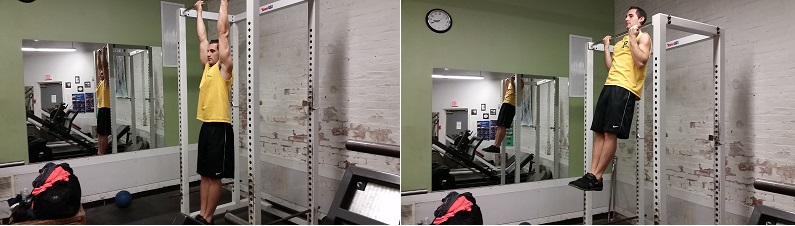
*Throughout this session perform full range of motion, strict chin-ups. If you cannot do them, get assistance from a band or a partner. Avoid pull-down and assisted pull up machines if possible.
Sets: You can execute these wherever you choose. Just make certain you complete the number of reps instructed above by the end of this session. If you can perform 10 strict chin ups or more in a single set, add enough resistance to where 6-8 reps would be your max instead.
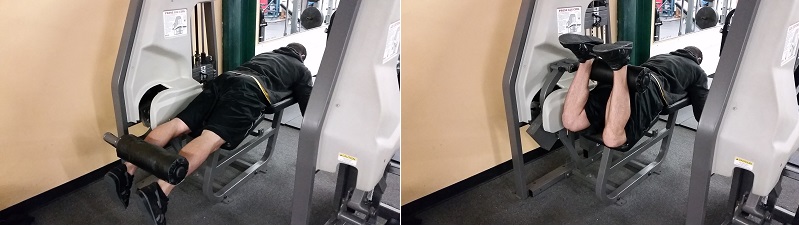
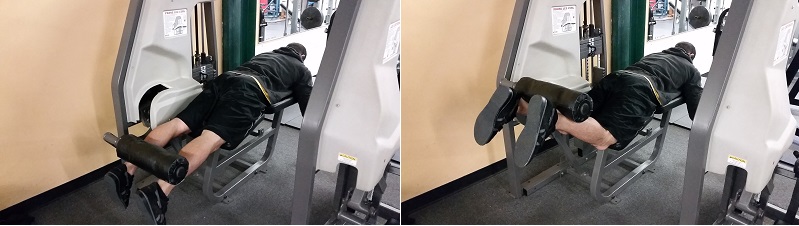
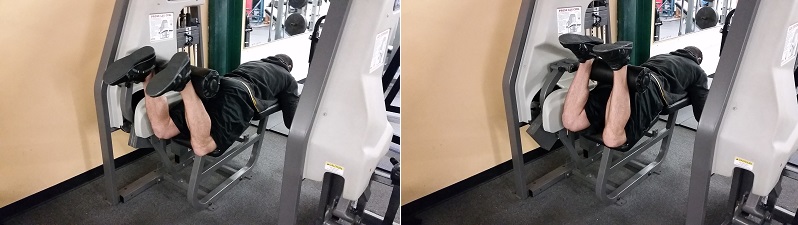
A1) Lying hamstring curls w/special technique
Special technique:
Perform 5 full reps.
Then execute 5 bottom-half partial reps.
Next do 5 top-half partial reps.
To finish, perform an isometric hold for 5 seconds with the hamstrings at full contraction.
Sets: 3 Reps: 5 full/5 bottom-half/5 top-half/5 sec isometric hold Rest between sets: 60 seconds
Complete all sets of A before moving onto B.
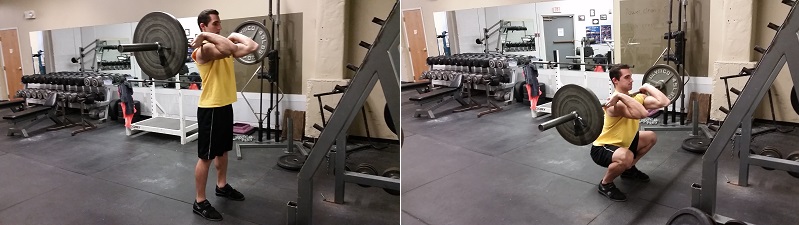
B1) Paused front squats
Week 1: 3×6 (120 seconds rest between sets) -Choose a weight you can perform all sets and reps with leaving 1-2 reps “in the tank”. Week 2: 4×6 (120 seconds rest between sets) -Use same weight as week 1. Week 3: 5×6 (120 seconds rest between sets) -Use same weight as weeks 1 and 2. Week 4: 3×3 (150 seconds rest between sets) -Perform with more weight than previous weeks. Week 5: 4×3 (150 seconds rest between sets) – Use same weight as week 4. Week 6: 5×3 (150 seconds rest between sets) – Use same weight as week 4 and 5.
Week 7: 2×12 (180 seconds rest between sets) -Choose a weight you can perform all sets and reps with leaving at least 2 reps “in the tank”. Do not pause at the bottom this week.
Week 8: 3×6 (120 seconds rest between sets) -Use more weight than week 1. Week 9: 4×6 (120 seconds rest between sets) -Use same weight as week 8. Week 10: 5×6 (120 seconds rest between sets) -Use same weight as weeks 8 and 9. Week 11: 2×3 (150 seconds rest between sets) -Perform with more weight than week 4. Week 12: 3×3 (150 seconds rest between sets) -Perform with same weight as week 11.
C1) Romanian deadlifts (you can use straps with these if wanted)
Week 1: 3×10 (75 seconds rest between sets) -Choose a weight you can perform all sets and reps with leaving 1-2 reps “in the tank”. Week 2: 3×12 (75 seconds rest between sets) -Use same weight as week 1. Week 3: 3×15 (75 seconds rest between sets) -Use same weight as weeks 1 and 2. Week 4: 3×10 (75 seconds rest between sets) -Perform with more weight than previous weeks. Week 5: 3×12 (75 seconds rest between sets) -Use same weight as week 4. Week 6: 3×15 (75 seconds rest between sets) -Use same weight as week 4 and 5.
Week 7: 2×12 (120 seconds rest between sets) -Choose a weight you can perform all sets and reps with leaving at least 2 reps “in the tank”.
Week 8: 3×10 (75 seconds rest between sets) -Use more weight than week 1. Week 9: 3×12 (75 seconds rest between sets) -Use same weight as week 8. Week 10: 3×15 (75seconds rest between sets) -Use same weight as weeks 8 and 9. Week 11: 2×10 (75 seconds rest between sets) -Perform with more weight than week 4. Week 12: 3×10 (75 seconds rest between sets) -Perform with same weight as week 11.
D1) Standing calf raises
Week 1: 3×12-15 (60 seconds rest between sets) Establish a working weight. Week 2: 4×12-15 (60 seconds rest between sets) Use same weight as week 1. Week 3: 3×12-15 (45 seconds rest between sets) Use same weight as week 1. Week 4: 4×12-15 (45 seconds rest between sets) Use same weight as week 1. Week 5: 3×12-15 (30 seconds rest between sets) Use same weight as week 1. Week 6: 4×12-15 (30 seconds rest between sets) Use same weight as week 1.
Week 7: 2×12 (90 seconds rest between sets) -Choose a weight you can perform all sets and reps with leaving at least 2 reps “in the tank”.
Week 8: 3×12-15 (60 seconds rest between sets) -Use more weight than week 1. Week 9: 3×12-15 (60 seconds rest between sets) -Use same weight as week 8. Week 10: 3×12-15 (45 seconds rest between sets) -Use same weight as weeks 8 and 9. Week 11: 2×12-15 (45 seconds rest between sets) -Perform with more weight than week 4. Week 12: 3×12-15 (30 seconds rest between sets) -Perform with same weight as week 11.
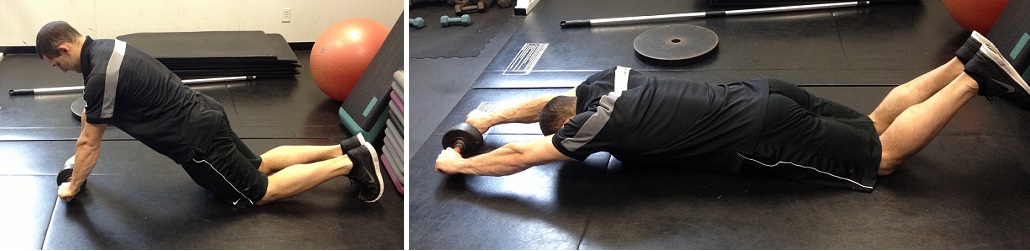
D2) Ab dolly rollouts from the knees
Sets: 3 Reps: 8-15 Rest time between sets: 45 seconds
UPPER BODY ONE
A1) Head supported dumbbell rear deltoid raises w/special technique
Special technique:
Perform the reps listed below with full range of motion.
Add 10 more bottom-half partial reps to each set.
Week 1: 3×15 (45 seconds rest between sets) Establish a working weight. Week 2: 3×20 (45 seconds rest between sets) Use same weight as week 1. Week 3: 3×25 (45 seconds rest between sets) Use same weight as week 1. Week 4: 3×10 (60 seconds rest between sets) Increase resistance above the previous weeks. Week 5: 3×12 (60 seconds rest between sets) Use same weight as week 5. Week 6: 3×15 (60 seconds rest between sets) Use same weight as week 6.
Week 7: 2×12 (90 seconds rest between sets) -Choose a weight you can perform all sets and reps with leaving at least 2 reps “in the tank”.
Week 8: 3×20 (45 seconds rest between sets) Use more weight than week 1. Week 9: 3×25 (45 seconds rest between sets) Use same weight as week 8. Week 10: 3×30 (45 seconds rest between sets) Use same weight as week 8 and 9. Week 11: 3×10 (60 seconds rest between sets) Increase the resistance above what you used week 4. Week 12: 3×12 (60 seconds rest between sets) Use same weight as week 11.
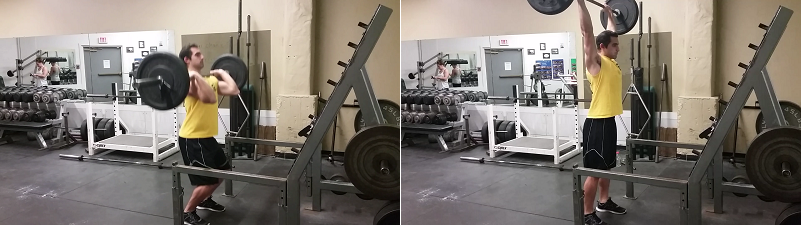
B1) Push Press with 4 second eccentric
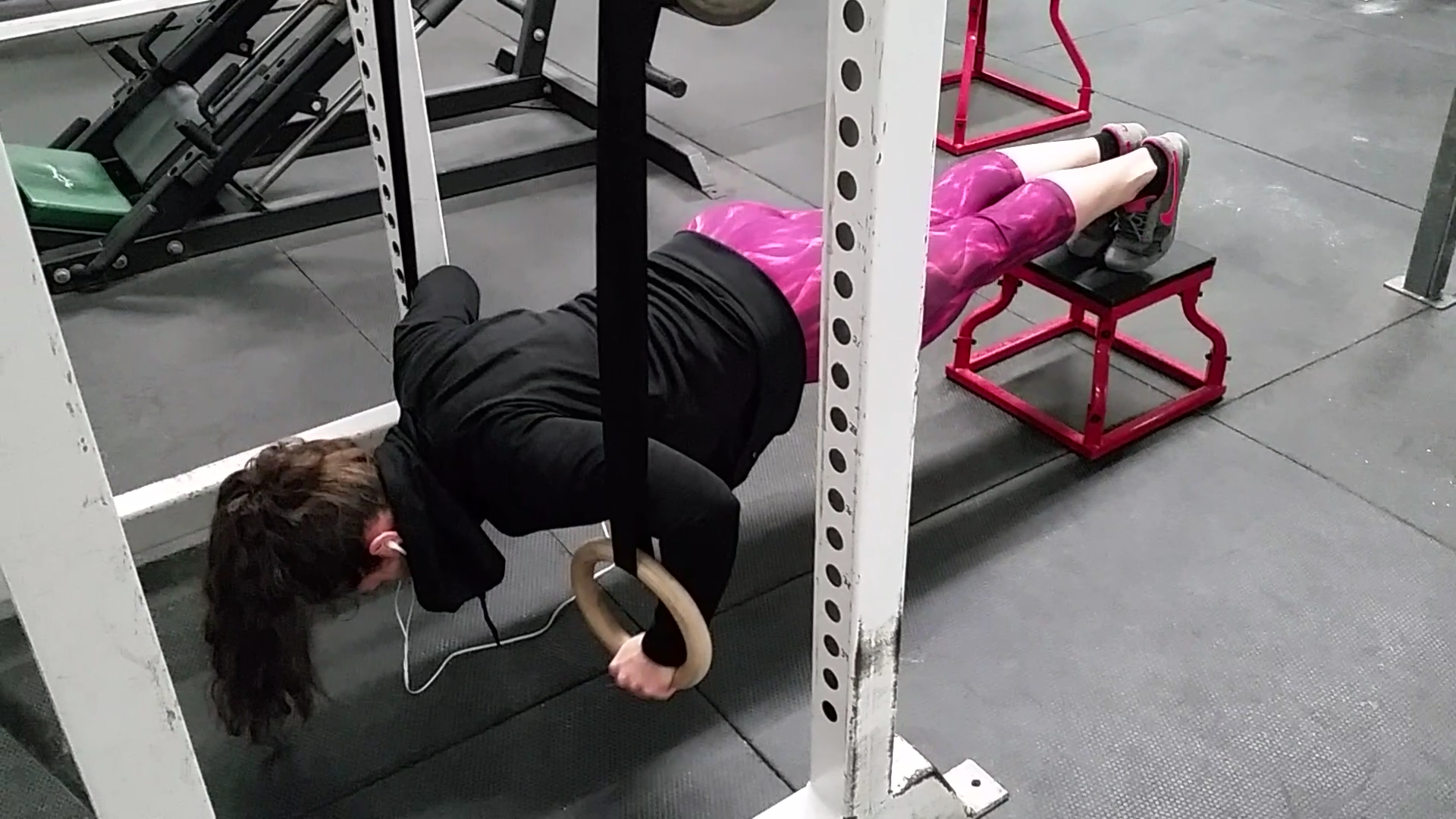
Week 1: 3×6 (120 seconds rest between sets) -Choose a weight you can perform all sets and reps with leaving 1-2 reps “in the tank”. Week 2: 4×6 (120 seconds rest between sets) -Use same weight as week 1. Week 3: 5×6 (120 seconds rest between sets) -Use same weight as weeks 1 and 2. Week 4: 3×3 (150 seconds rest between sets) -Perform with more weight than previous weeks. Week 5: 4×3 (150 seconds rest between sets) – Use same weight as week 4. Week 6: 5×3 (150 seconds rest between sets) – Use same weight as week 4 and 5.
Week 7: 2×8: (180 seconds rest between sets) -Choose a weight you can perform all sets and reps with leaving at least 2 reps “in the tank”. Do not use a slow 4 second eccentric this week, instead lower down with a count of 1-2 seconds.
Week 8: 3×6 (120 seconds rest between sets) -Use more weight than week 1. Week 9: 4×6 (120 seconds rest between sets) -Use same weight as week 8. Week 10: 5×6 (120 seconds rest between sets) -Use same weight as weeks 8 and 9. Week 11: 3×3 (150 seconds rest between sets) -Perform with more weight than week 4. Week 12: 4×3 (150 seconds rest between sets) – Use same weight as week 11.
C1) 1 arm dumbbell row
Special technique:
Hold for 2 seconds at full contraction of each rep
Hold for 5 seconds at full contraction on the last rep of each set.
Sets: 3 Reps: 8 per side Rest: 30 seconds then perform C2)
C2) Triceps pushdowns
Sets: 3 Reps: 8 Rest: 75 seconds then back to C1)
Perform 1 set of C1) rest 30 seconds, then perform one set of C2) and rest 75 seconds. Repeat this until all of your sets are completed.
D1) Front side raises (50 reps total)
Sets: Ideally 1-2 (or as many as it takes you) Reps: 25 front raises/25 side raises
Perform one front raise, then one side raise. Repeat this until you get to 50 reps total or 25 reps of each using minimal to no rest.
Use controlled momentum as needed to finish the reps.
LOWER BODY TWO
A1) One step vertical jumps
Sets: 3 Reps: 6 (alternate the lead foot) Rest between sets: 30 seconds
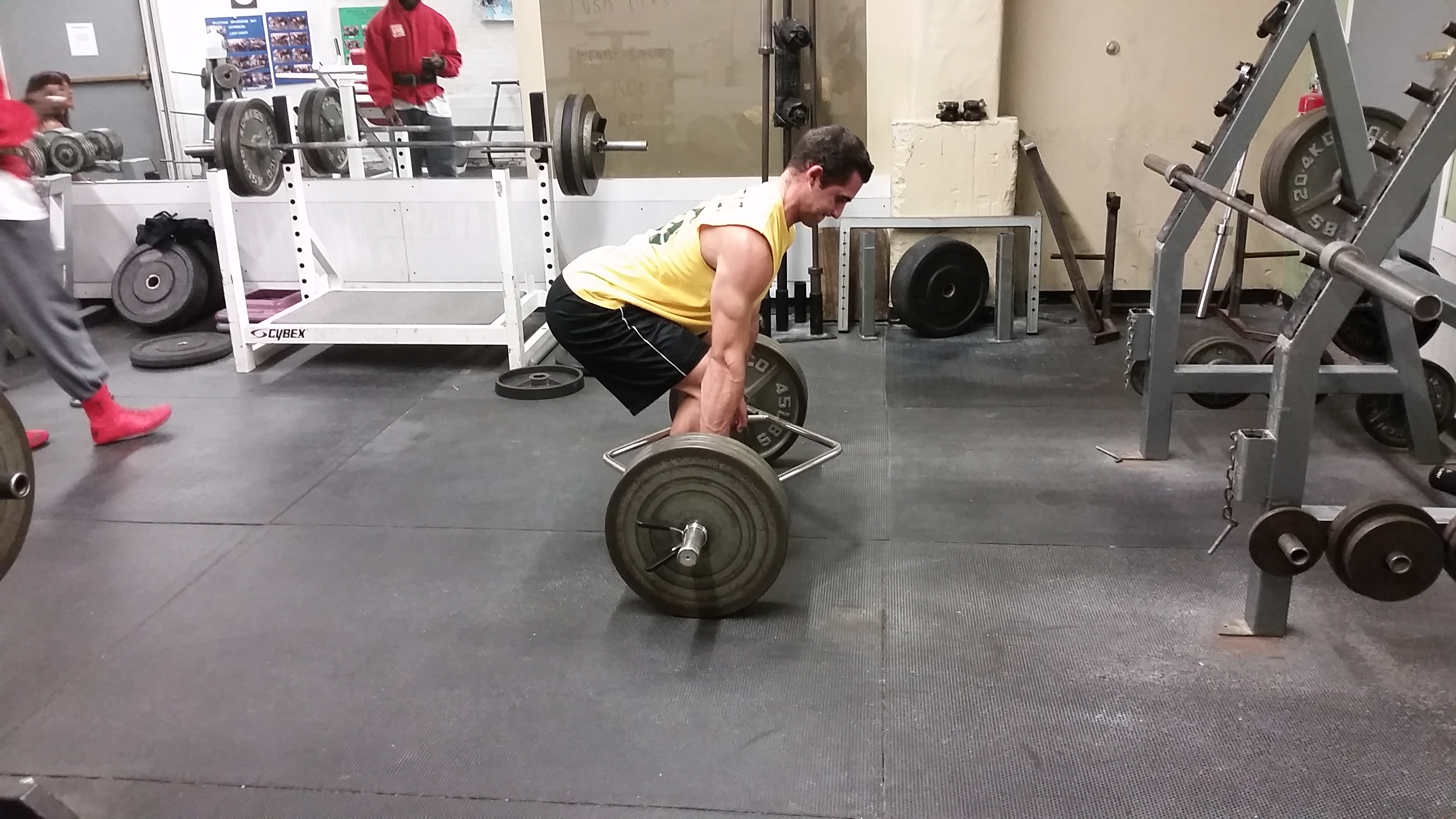
B1) Trap bar deadlift
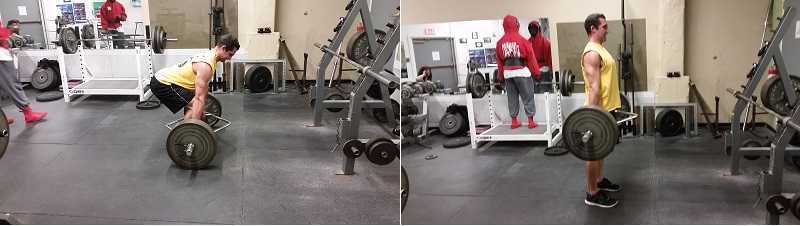
Week 1: 1×5 (180-210 seconds rest between sets) -Choose a weight you can perform all sets and reps with leaving 1-2 reps “in the tank”. Week 2: 1×6 (180-210 seconds rest between sets) -Use same weight as week 1. Week 3: 1×7 (180-210 seconds rest between sets) -Use same weight as weeks 1 and 2. Week 4: 1×5 (180-210 seconds rest between sets) -Perform with more weight than previous weeks. Week 5: 1×6 (180-210 seconds rest between sets) – Use same weight as week 4. Week 6: 1×7 (180-210 seconds rest between sets) – Use same weight as week 4 and 5.
Week 7: 2×10 (210 seconds rest between sets) -Choose a weight you can perform all sets and reps with leaving at least 2 reps “in the tank”. If you have straps, use them this week.
Week 8: 1×5 (180-210 seconds rest between sets) -Use more weight than week 1. Week 9: 1×6 (180-210 seconds rest between sets) -Use same weight as week 8. Week 10: 1×7 (180-210 seconds rest between sets) -Use same weight as weeks 8 and 9. Week 11: 1×5 (180-210 seconds rest between sets) -Perform with more weight than week 4. Week 12: 1×6 (180-210 seconds rest between sets) – Use same weight as week 11.
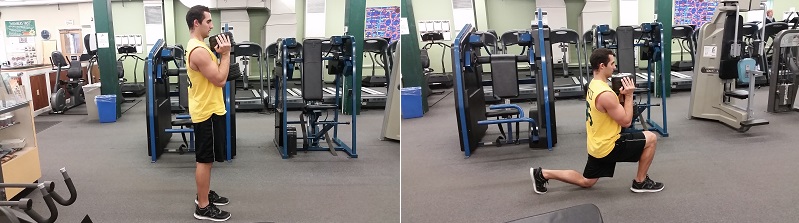
C1) Walking goblet lunges (with 4 second eccentric)
Week 1: 3×6 per leg (90 seconds rest between sets) -Choose a weight you can perform all sets and reps with leaving 1-2 reps “in the tank”. Week 2: 3×8 per leg (90 seconds rest between sets) -Use same weight as week 1. Week 3: 3×10 per leg (90 seconds rest between sets) -Use same weight as weeks 1 and 2. Week 4: 3×6 per leg (90 seconds rest between sets) -Perform with more weight than previous weeks. Week 5: 3×8 per leg (90 seconds rest between sets) – Use same weight as week 4. Week 6: 3×10 per leg (90 seconds rest between sets) – Use same weight as week 4 and 5.
Week 7: 2×6 per leg (120 seconds rest between sets) -Choose a weight you can perform all sets and reps with leaving at least 2 reps “in the tank”. Do not use a slow 4 second eccentric this week, instead lower down with a count of 1-2 seconds.
Week 8: 3×6 per leg (90 seconds rest between sets) -Use more weight than week 1. Week 9: 3×8 per leg (90 seconds rest between sets) -Use same weight as week 8. Week 10: 3×10 per leg (90 seconds rest between sets) -Use same weight as weeks 8 and 9. Week 11: 3×6 per leg (90 seconds rest between sets) -Perform with more weight than week 4. Week 12: 3×8 per leg (90 seconds rest between sets) – Use same weight as week 11.
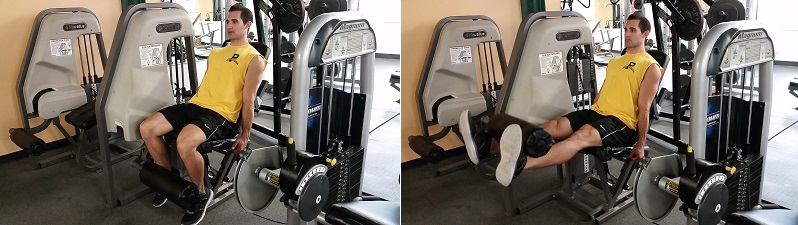
D1) Leg extensions
Week 1: 3×10 (60 seconds rest between sets) -Choose a weight you can perform all sets and reps with leaving 1-2 reps “in the tank”. Week 2: 3×12 (60 seconds rest between sets) -Use same weight as week 1. Week 3: 3×15 (60 seconds rest between sets) -Use same weight as weeks 1 and 2. Week 4: 3×10 (60 seconds rest between sets) -Perform with more weight than previous weeks. Week 5: 3×12 (60 seconds rest between sets) – Use same weight as week 4. Week 6: 3×15 (60 seconds rest between sets) – Use same weight as week 4 and 5.
Week 7: 2×12 (90 seconds rest between sets) -Choose a weight you can perform all sets and reps with leaving at least 2 reps “in the tank”.
Week 8: 3×10 (60 seconds rest between sets) -Use more weight than week 1. Week 9: 3×12 (60 seconds rest between sets) -Use same weight as week 8. Week 10: 3×15 (60 seconds rest between sets) -Use same weight as weeks 8 and 9. Week 11: 3×10 (60 seconds rest between sets) -Perform with more weight than week 4. Week 12: 3×12 (60 seconds rest between sets) – Use same weight as week 11.
E1) Seated calf raises
Sets: 3 Reps: 12-15 Rest between sets: None, go right into E2).
E2) Hanging leg raises
Sets: 3 Reps: 5-15 or as many as your body allows Rest between sets: 45 seconds then back into E1).
Perform one set of E1) then with minimal to no rest perform one set of E2). From here, rest 45 seconds and repeat until all sets are completed.
UPPER BODY TWO
A1) Plyometric push ups
Sets: 3 Reps: 3-5 Rest time between sets: 30 seconds
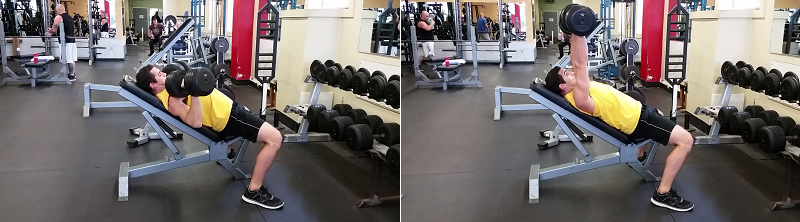
B1) Incline dumbbell bench press
Week 1: 3×8 (120 seconds rest between sets) -Choose a weight you can perform all sets and reps with leaving 1-2 reps “in the tank”. Week 2: 4×8 (120 seconds rest between sets) -Use same weight as week 1. Week 3: 5×8 (120 seconds rest between sets) -Use same weight as weeks 1 and 2. Week 4: 3×5 (150 seconds rest between sets) -Perform with more weight than previous weeks. Week 5: 4×5 (150 seconds rest between sets) – Use same weight as week 4. Week 6: 5×5 (150 seconds rest between sets) – Use same weight as week 4 and 5.
Week 7: 2×12 (180 seconds rest between sets) -Choose a weight you can perform all sets and reps with leaving at least 2 reps “in the tank”.
Week 8: 3×8 (120 seconds rest between sets) -Use more weight than week 1. Week 9: 4×8 (120 seconds rest between sets) -Use same weight as week 8. Week 10: 5×8 (120 seconds rest between sets) -Use same weight as weeks 8 and 9. Week 11: 3×5 (150 seconds rest between sets) -Perform with more weight than week 4.. Week 12: 4×5 (150 seconds rest between sets) – Use same weight as week 11.
C1) Wide Grip Flat barbell bench Press with 4 second eccentric
Week 1: 3×4 (120 seconds rest between sets) -Choose a weight you can perform all sets and reps with leaving 1-2 reps “in the tank”. Week 2: 3×5 (120 seconds rest between sets) -Use same weight as week 1. Week 3: 3×6 (120 seconds rest between sets) -Use same weight as weeks 1 and 2. Week 4: 3×4 (120 seconds rest between sets) -Perform with more weight than previous weeks. Week 5: 3×5 (120 seconds rest between sets) – Use same weight as week 4. Week 6: 3×6 (120 seconds rest between sets) – Use same weight as week 4 and 5.
Week 7: 2×4 (150 seconds rest between sets) -Choose a weight you can perform all sets and reps with leaving at least 2 reps “in the tank”. Do not use a slow 4 second eccentric this week, instead lower down with a count of 1-2 seconds.
Week 8: 3×4 (120 seconds rest between sets) -Use more weight than week 4 Week 9: 3×5 (120 seconds rest between sets) -Use same weight as week 8. Week 10: 3×6 (120 seconds rest between sets) -Use same weight as weeks 8 and 9. Week 11: 3×4 (120 seconds rest between sets) -Perform with more weight than week 8. Week 12: 3×5 (120 seconds rest between sets) – Use same weight as week 11.
D1) Hammer strength row
Week 1: 3×6 (90 seconds rest between sets) -Choose a weight you can perform all sets and reps with leaving 1-2 reps “in the tank”. Week 2: 3×8 (90 seconds rest between sets) -Use same weight as week 1. Week 3: 3×10 (90 seconds rest between sets) -Use same weight as weeks 1 and 2. Week 4: 3×6 (90 seconds rest between sets) -Perform with more weight than previous weeks. Week 5: 3×8 (90 seconds rest between sets) – Use same weight as week 4. Week 6: 3×10 (90 seconds rest between sets) – Use same weight as week 4 and 5.
Week 7: 2×12 (120 seconds rest between sets) -Choose a weight you can perform all sets and reps with leaving at least 2 reps “in the tank”.
Week 8: 3×6 (90 seconds rest between sets) -Use more weight than week 1. Week 9: 3×8 (90 seconds rest between sets) -Use same weight as week 8. Week 10: 3×10 (90 seconds rest between sets) -Use same weight as weeks 8 and 9. Week 11: 3×6 (90 seconds rest between sets) -Perform with more weight than week 4 Week 12: 3×8 (90 seconds rest between sets) – Use same weight as week 11.
E1) Barbell biceps curls w/special technique
Special technique:
Curl the barbell.
Lower it down for a count of 3 seconds.
On the last rep you lower down, hold the barbell at midpoint for 5 seconds.
Sets: 4 Reps: 6 Rest time between sets: 30 seconds then right into E2)
Go through exercises A1-A5, in order, with the prescribed number of reps above, and parameters below.
Week 1: 1-2 rounds (90 seconds rest after each round) -Minimal to no rest between exercises. Week 2: 2-3 rounds (90 seconds rest after each round) -Minimal to no rest between exercises. Week 3: 3-4 rounds (90 seconds rest after each round) -Minimal to no rest between exercises. Week 4: 1-2 rounds (90 seconds rest after each round) -Minimal to no rest between exercises. Week 5: 2-3 rounds (90 seconds rest after each round) -Minimal to no rest between exercises. Week 6: 3-4 rounds (90 seconds rest after each round) -Minimal to no rest between exercises.
Week 7: 1-2 rounds (120 seconds rest after each round) -30 seconds rest between exercises.
Week 8: 1-2 rounds (90 seconds rest after each round) -Minimal to no rest between exercises. Week 9: 2-3 rounds (90 seconds rest after each round) -Minimal to no rest between exercises. Week 10: 3-4 rounds (90 seconds rest after each round) -Minimal to no rest between exercises. Week 11: 1-2 rounds (90 seconds rest after each round) -Minimal to no rest between exercises. Week 12: 2-3 rounds (90 seconds rest after each round) -Minimal to no rest between exercises.
Some Training Schedule Options
Option #1
Day One: Lower Body 1 (Quads, hamstrings, calves, core, chin ups) Day Two: Off Day Three: Upper Body 1 (Shoulder’s, back, triceps) Day Four: Off Day Five: Lower Body 2 (Quads, hamstrings, claves, core, traps) Day Six: Upper Body 2 (Chest, back, biceps, triceps) Day Seven: *Optional day
Option #2
Day One: Lower Body (Quads, hamstrings, calves, core, chin ups) Day Two: Upper Body (Shoulder’s, back, triceps) Day Three: Off Day Four: Lower Body (Quads, hamstrings, claves, core) Day Five: Off Day Six: Upper Body (Chest, back, biceps, triceps) Day Seven: *Optional day
Option #3
Day One: Lower Body (Quads, hamstrings, calves, core, chin ups) Day Two: Upper Body (Shoulder’s, back, triceps) Day Three: Off Day Four: Lower Body (Quads, hamstrings, claves, core) Day Five: Upper Body (Chest, back, biceps, triceps) Day Six: Off Day Seven: *Optional day
This program is for you if you have been “stuck” at the same fitness level for a while. It propels you into a stretch of land with less restrictions, as you get under weights, sets, and reps, you might have otherwise thought weren’t within your power or capacity.
It’s really nice to execute something drastically different than you’re used to both physically and psychologically. If you train in a local or commercial health club, this program should fit your schedule nicely. Step out your comfort zone, give this a shot, and let me know how it goes. Feel free to take recognition and celebrate your new results a well.